

The market for Egyptian antiquities is thriving in 2025, both locally and globally. With the Grand Egyptian Museum (GEM) now open, recent restitution campaigns, and strong auction results, collectors, investors, and museum professionals are closely watching this dynamic sector.
This guide is designed for:
- Egypt enthusiasts,
- owners of ancient artifacts curious about their value,
- those considering selling or unsure whether to sell.
🌍Global Market Overview
International demand for Egyptian antiquities remains robust. Auction houses and galleries report record-breaking sales:
- Christie’s London: Bronze falcon statues sold for over £630,000.
- Christie’s New York: A full set of four canopic jars sold for $203,200.
- Apollo Art Auctions, London: Bronze, faience, and stone pieces performed strongly in 2024–2025.
Collectors prioritize well-documented provenance and museum-quality condition, which drives prices higher and sustains market confidence.
Need a professional valuation for your Egyptian antiquity?
🏛Egypt: Heritage Revival and Economic Dynamics
The opening of the Grand Egyptian Museum (GEM) in Giza marks a milestone: it is the largest museum dedicated to a single civilization, displaying over 100,000 artifacts, including the complete Tutankhamun collection.
Restitution campaigns and heritage policies led by Zahi Hawass and the Ministry of Antiquities increase the scarcity of high-quality artifacts on the private market, influencing international prices.
Economically, Egypt’s investment in cultural tourism and museum development continues to strengthen local and regional interest in antiquities, providing stability for owners considering sales or donations.
📊Market Values 2025 (USD)
| Category | Type of Object | Estimated Value 2025 | Notes |
| Major / Museum-quality | Complete canopic jar sets | $150,000 – $250,000 | Record sale $203,200 in 2025 |
| Large bronze statues (Horus, Osiris, Ptah) | $30,000 – $150,000 | Strong demand in galleries | |
| High-quality reliefs | $40,000 – $250,000 | Rare outside museums | |
| Funerary masks / sarcophagi | $100,000 – $300,000 | Extremely rare on private market | |
| Intermediate | Faience figurines | $2,000 – $12,000 | Condition-dependent |
| Relief fragments | $3,000 – $25,000 | Text legibility increases value | |
| Ostraca (inscribed pottery) | $800 – $6,000 | Popular among specialized collectors | |
| Ushabti | $600 – $8,000 | Material and era impact price | |
| Ancient jewelry (scarabs, necklaces) | $500 – $15,000 | Complete pieces fetch higher prices | |
| Small / Accessible | Amulets | $100 – $1,200 | Wide price range |
| Faience fragments, funerary beads | $40 – $400 | Popular with entry-level collectors | |
| Sculptural fragments | $150 – $2,000 | High variability | |
| Small everyday artifacts | $80 – $700 | Frequently sold in Paris & London |
Note: Royal tomb artifacts, Tutankhamun items, and monumental statues are typically museum-only and not legally available on the private market.
📈 Market Trends (2010–2025)
- +35% to +70% increase for museum-quality pieces with verified provenance.
- +10% to +20% increase for intermediate artifacts.
- Stable or decreasing values for items lacking clear documentation.
- Rarity of major pieces continues to push prices upward.
🏛Key Market Players
In Egypt
- Grand Egyptian Museum (GEM)
- National Museum of Egyptian Civilization (NMEC)
- Ministry of Antiquities
- Zahi Hawass Center for Egyptology
International
- Auction Houses: Christie’s, Sotheby’s, Bonhams, Apollo Art Auctions, Drouot
- Galleries: David Aaron, Ariadne, Safani Gallery, Kallos Gallery
- Museums: MET, British Museum, Louvre, Neues Museum, Turin Museum
- Curators, conservators, and major private collectors
🔎For Artifact Owners
- Document everything: receipts, old photos, certificates.
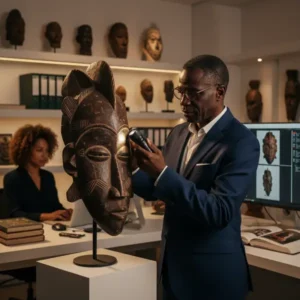
- Professional appraisal is essential before selling, insuring, or donating.
- Even small items can have high value if provenance and condition are verified.
- Pieces with clear documentation may sell 3–10x higher than undocumented equivalents.
Curious about the latest auction prices for Egyptian antiquities ?
Use our Free Auction Search Tool to see real-time market data.
Guide: How to Get Your Egyptian Artifact Appraised
Why Appraisal Matters
Egyptian antiquities are highly sought after but tightly regulated. A professional appraisal ensures:
- Correct identification of period, material, and craftsmanship
- Confirmation of authenticity
- Accurate market value
- Legal compliance for sale or export
Step 1 — Gather Documentation
- Purchase receipts, old family photos, certificates, archives, letters, and inventories.
Step 2 — Photograph the Object
- Multiple angles, details of material, measurements. Include a scale reference (ruler or coin).
Step 3 — Preliminary Specialist Review
- Determine period (e.g., Old Kingdom, Ptolemaic, New Kingdom)
- Identify typology (amulet, ushabti, relief, fragment)
- Assess material (faience, stone, bronze, wood)
Step 4 — Choose a Reputable Expert or Institution
- Europe: Christie’s, Drouot, David Aaron, Ariadne
- USA: MET Department of Egyptian Art, certified independent appraisers
- UK: British Museum Egyptology curators, Egypt Exploration Society
- Egypt: GEM, NMEC, Ministry of Antiquities
Tip: Avoid fast, uncertified appraisals.
Step 5 — Scientific Analysis (if needed)
- Material dating, metallography, imaging, surface study, pigment spectroscopy
Step 6 — Market Valuation
- Auction estimate, gallery price, private sale, or insurance valuation
Step 7 — Legal Verification
- Confirm compliance with UNESCO 1970 Convention and export laws
Key Takeaway: Proper appraisal protects your artifact, enhances its value, and ensures legal security.
Understanding the specific aesthetics of Egyptian antiquities is crucial, but it is only one part of a professional appraisal. To fully grasp the worth of your art collection and protects against risks, you should refer to our Expert Guide: Why You Should Get Your Traditional African Art Appraised for Insurance.
Why trust our expertise? AfricArtMarket is the leading online authority for African art appraisal. Providing continuous market analysis since 2015, we help collectors secure their investments and accurately value their heritage in today’s global market.