Skip to content
Said Rais, born in 1986
Ottersbach, Heribert C.
1966 Cologne - lives and works in in Leipzig + Sörmland
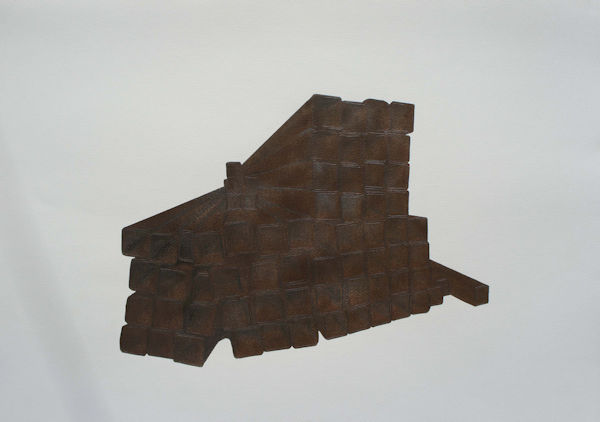
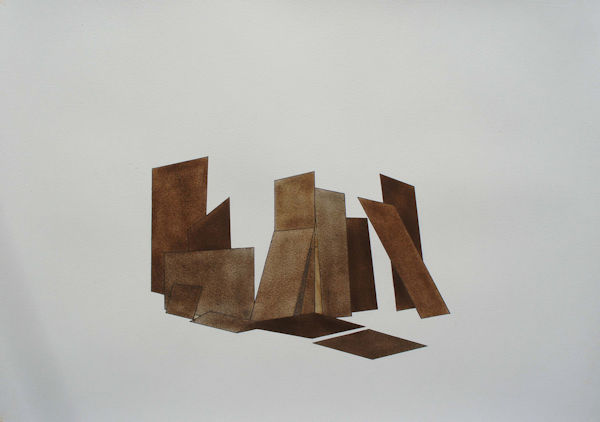
Untitled (Cat. Rais.: HCO-0045/93).
1993. Unique Photocollage. Gelatin silver prints, C-Prints, Images from newspapers, b/w copies, drawing board. Mat. 56,9 x 47,8cm Individual images are partially inscribed with black pen or pencil. Signed, dated, titled, and with the catalogue raisonne number on the verso.
Published in: Heribert C. Ottersbach. Publisher.: Klaus Honnef. Exhibition catalogue. Rheinisches Landesmuseum u.a. Bramsche: Rasch Verlag, 1993. Fig. Table 77 pp. 88.
In an interview with Eckhart Gillen, Heribert Ottersbach said of his montages:
In the montages, I often intentially leave certain elements, like shadows of a memory. I avoid clear attributions when I am assembling fantastic architecture with the help of montage. I work knowingly with templates that open up certain horizons of meaning while viewing, but which have nothing to do with the concrete photograph. (ebd. pp. 89).
Provenance: From the artist to the current owner.
w - `LES PÉCHEURS', A GOBELINS TAPESTRY, WOVEN BETWEEN 1692-1740, FROM THE SERIES LES ANCIENNES INDES, AFTER CARTOONS BY ALEXANDRE-FRANCOIS DESPORTES, BASED ON PAINTINGS BY ALBERT VAN DER EECKHOUT AND FRANS POST COMMISSIONED BY PRINCE MAURICE OF NASSAU AND GIVEN TO LOUIS XIV IN 1679
456cm. high, 322cm. wide, 14ft. 11in., 10ft. 6in.
woven basse lisse, within the `première' four-sided borders of gold and red alternating acanthus leaf and guilloche bands on a blue ground, with further narrow inner husk and outer red and gold banded borders, with blue outer selvedge
the reverse with a section of old lining marked in ink with: No 158. INDIENS. 8.P.4. au, 2 au 3/4
PROVENANCE
Collection of H. Braquenie, sold 18&upsilon,th May 1897
Collection Carlos de Beistegui, Labia Palace, Venice, sold 6-10&upsilon,th April 1964
Private Collection
PALAZZO LABIA
This Palazzo Labia, past home to the present Indes tapestries, has association with an intoxicatingly exuberant era and style which stands out in the history of Venice and society living.
Palazzo Labia, is a Venetian, Baroque, palazzo built at the beginning of the 18th century. It is most notable for containing a most remarkable room painted between (1746-47) by Giovanni Battista Tiepolo, with decorative works in trompe l'oeil by Gerolamo Mengozzi-Colonna. The palazzo was designed by the architect Andrea Cominelli. During the 19th century the Palazzo fell into decay, this also coincided with a period where Tiepolo's work was unpopular and unappreciated. In 1945 a munitions boat exploded close to the palazzo shattering its already precarious foundations. The Labia family, who commissioned the palazzo, were originally Spanish. In the latter half of the 20th century the palazzo acquired a new owner Don Carlos de Beistegui, heir to a Mexican silver fortune. He commenced a programme of structural restoration and as a skilled interior decorator, purchased for the derelict palazzo furnishings acquired from many of the palazzo's less fortunate neighbours including frescoes by Raphael, Annibale Carracci, and Guido Reni, these works of art coupled with newly acquired tapestries and antiques restored to the palazzo some of its former splendour. So avid a collector was Don Carlos that his taste became known as le goût Beistegui (the Beistegui style).
On 3rd September 1951 Don Carlos threw a party at the Palazzo Labia, a costume ball `Le Bal Oriental' (Bal Beistegui), which was one of the largest and most lavish social events of the 20th century. It launched the career of the Venetian fashion designer Pierre Cardin, who designed about thirty of the costumes worn by members of the dolce vita who attended. Cecil Beaton's photographs of the ball display an almost surreal society, reminiscent of the Venetian life immediately before the fall of the republic at the end of the 18th century. The party was to be one of the last truly spectacular events in the famous ballroom
An auction of objects belonging to Don Carlos in 1964, included many items from his collection including the four Anciennes Indes tapestries. Don Carlos died in 1970 leaving the palazzo in good repair, and many of newly acquired works of art to the Louvre in Paris, and others bequeathed to his heir along with his French home Château de Groussay which was similarly furnished. When this collection, together with some of the Palazzo Labia's former contents was auctioned by Sotheby's in 1999 it proved to be France's largest and a highly priced auction. Today the palazzo is no longer a private residence, but regional headquarters of Rai (the Italian National Television).
LA MAISON BRAQUENIÉ
The name Braquenié is synonymous with highly sought after exotic, tasteful and glamorous textiles. Henri Braquenié played a large part in establishing this reputation.
Founded at the beginning of the 19th century by Mr. Demy Doineau (1798-1848), during a period in which France had established itself in the domain of the decorative arts. Braquenié was able to create a universe of matching rugs and fabrics for the most prestigious décors. In 1821, Pierre-Antoine Demy and his wife took over the family business and set up in rue Vivienne in Paris where they assembled the most beautiful collections of rugs and tapestries in the capital. The business was successful from the start and in 1830, was named by King Louis-Philippe as silk fabric merchant to the King. Ten years later, it acquired the atelier de Paris in Aubusson and then implemented a policy of creating exclusive models which were to make it famous.
In the middle of the 19th century in partnership with Alexandre Braquenié (1812-1879), the house offered everything flourishing society could want. In 1848, Alexandre found in his son-in-law, Henri Braquenié, (1815-1897) a new associate. During forty-nine years, H. Braquenié directed the house. An auction of his collection in 1897 is recorded.
The house continued to be preminent in its field. The Empress Eugénie and Napoléon III, Duc Pozzo di Borgo, the Marquess de la Païva and the Rothschild family all became loyal clients. Official orders flooded in: a rug was woven for the Palais du Luxembourg, another for Notre Dame de Paris and for the Vatican. Its reputation extended beyond the borders of France, with the courts of Spain, Italy and Russia and Sultan Said, the pasha of Egypt, ordering their décors from Braquenié. Prestigious orders continued to be the mainstay of the business during the 19th century, for example those completed for the liner Normandie and replicas of historic décors, notably for the Grand Trianon. Braquenié always blended tradition and innovation, associating reproductions of forgotten designs with orders from a number of new designers. It has regularly worked in partnership with contemporary artists, the most famous of which were Picart-Le-Doux, Saint-Saëns and Lurçat.
In 1991, the company Pierre Frey bought this living cultural heritage. Respectful of the glorious past of the old established house, it has preserved its soul while bringing it into the 21st century. In 2003, Patrick Frey created a department responsible for bringing together and reorganising all the archives relating to the history of Braquenié. Its mission is to preserve this varied inheritance enriched with designs and acquisitions, to propose new sources of inspiration to the Group's design bureaux and offer clients and interior decorators a customised service. Today, Braquenié concentrates on the textile trades (silk, prints and weaves) and custom made rugs, and has entrusted Sotheby's with the dispersion of part of its tapestry related documentation. Braquenié has chosen to carefully conserve its textile archives and will continue to add to them.
LITERATURE
These tapestries at the end of the 17&upsilon,th century introduced a novel and exotic subject which included luxuriant vegetation and use of `Indian' figures, and exuberance of conception which was favourably received.
The original cartoons were designed either in 1650 or 1663 by Albert Eeckhout (1610-1665) and Frans Post (1612-1680), with later alterations by Jean-Baptiste Monnoyer (1636-1699), Jean-Baptiste Belin de Fontenay (1653-1715), René-Antoine Houasse (1644/1645 - 1710) and François Bonnemer (1638-1689), There were modifications made by Alexandre François Desportes (1661-1743), and the series was woven between 1692-1730.
The titles of the eight Indes (Old Indies) tapestries were:-
Le Cheval Rayé (The Zebra), Les Deux Taureaux (The Two Bulls), L'Eléphant /or Le Cheval Isabelle (The Elephant /or The Horse Isabelle), Le Chasseur Indien (The Indian Hunter), Le Combat des Animaux (The Animal Fight), Le Ro
A YAMASHIRO RAI TACHI
ATTRIBUTED TO RAI KUNIMITSU, LATE KAMAKURA-NANBOKUCHO PERIOD (14th Century)
Sugata [configuration]: a broad and thick honzukuri, iori-mune, deep even curve, short chu-kissaki
Kitae [forging pattern]: fine and close itame-hada, somewhat flowing, rich in ji-nie, chikei, and with nie utsuri
Hamon [temperting pattern]: overall bright suguha with much variation, ko-choji with ko-gunome, many ashi and yo, of deep nioi with much nie, fine sunagashi and kinsuji, on the omote some hotsure near the habuchi, and small yubashiri following the crests of the yakiba
Boshi [tip]: ko-maru with slight hakikake
Horimono [carving]: bohi on both sides, on the omote kakinagasu to around the middle of the tang, on the ura kakitosu Nakago [tang]: o-suriage,katte sagari file marks, one mekugi-ana, kiri tip
Nagasa [length of blade]: 70.2cm
Koshirae [mounting]: in shirasaya
Unsigned.With a photo-certificate by Wolfgang Macke, Bonn, dated 20 Oct. 1969, with the estate stamp We would like to thank Ursula Heiderich, Syke, for kind information.August Macke's important painting “Kaffeetafel im Garten“ can be understood as narrative family portrait as well as significant evidence for the artist`s exceptional talent to allude to the world beyond its visible appearance by referring to its everyday phenomena.The garden played a central role in the Macke family, as is demonstrated not only by preserved photographs (see comparative ill. 1) but also by a whole series of drawings, watercolours and paintings by August Macke. He repeatedly recorded family gatherings during or at teatime in the form of paintings, for example, in “Im Garten: Elisabeth und Walterchen mit Wolf†- which features a closely related motif and is now part of the collection of Aachen's Ludwig Forum - or in the painting “Kinder im Gartenâ€, from the Kunstmuseum Bonn (see comparative illus. 2 and 3). Much like other motifs from his immediate surroundings, the artist chose the garden as much as a location as a setting.August Macke returned from the Tegernsee with his wife and their son Walter in November of 1910, and they moved into their house in Bonn's Bornheimerstraße in February of the following year. A total of twelve works from the year 1912, which the artist spent large parts of in the Rhineland, can be linked with the garden of their home: these include this family idyll in the garden during afternoon teatime (see Margarethe Jochimsen, Eingefangene Blicke, in: August Macke: Blickfänge in und um sein Bonner Haus, op. cit, p. 13). According to Wolfgang Macke among the depicted figures it is possible to identify August Macke's son Walter at the left, holding the hand of his great-grandmother Katharina Koehler, as well as Macke's wife Elisabeth and her mother Sophie Gehrhardt at the table behind them. Their German shepherd, Wolf, is lying on the grass to the right of the table.In terms of the composition Macke has arranged the group of three at the table in the centre of the painting, between trees in a bold green and a flower bed glowing in tones of red and yellow. His son Walter is positioned somewhat further in front, together with Katharina Koehler, and has been caught in mid-motion; his gaze and right arm seem to indicate the direction. Little Walter has thus been assigned the most active role in this tranquil garden scene. This detail may very well be worthy of note, considering that August Macke's formal vocabulary has repeatedly been symbolically interpreted in the context of his depictions of dreams and of paradise, for example, by Janice McCullagh, who has pointed to children as a symbol of continuity and the hope for a new world. Living in the eternal present they are said to find themselves in that self-assured state in which knowledge has not yet been divided into the subjective and objective, thus living in a pristine unity with nature (see Janice McCullagh, Mackes Paradiesvision, in: exhib. cat., August Macke, Gemälde, Aquarelle, Zeichnungen, Westfälisches Landesmuseum für Kunst- und Kulturgeschichte Münster/Städtisches Kunstmuseum Bonn/Städtische Galerie im Lenbachhaus München 1986/1987, p. 97).Macke's friend Franz Marc and his wife Maria visited Bonn in September and October of 1912, at approximately the same time as this painting was created. During this encounter they created the wall painting “Paradies†(see comparative illus. 4) together in Macke's studio. Filled with the dream of a harmonious, ideal state of the world, Macke's treatment of the theme of paradise is certainly rich in variety. Formally the wall painting in his studio may directly allude to the traditional pictorial subject of the Garden of Eden; however, in Macke's work the yearning for a new world does not necessarily reveal itself in the traditional modes of representing paradise. Much more often it takes on the appearance of cultivated nature, such as gardens and parks, urban landscapes or the zoological garden. Macke painted what he saw and, in this way, he was able to gently lead his viewers behind the veil of outward appearances without simultaneously taking away their sense for the immediacy, the forms, colours and structures of the world. Thus images of the material and immaterial merge into one another, metaphor and abstraction are combined. Entirely in the spirit of Schopenhauer, whose texts the artist knew, Macke composed scenes from everyday life and invested them with the spirit of the utopian: “Neither any individual nor any action can be without significance: in all of them and through them all the Idea of humanity more and more unfolds itself. […] For to hold firm, in an enduring image, the fleeting world undergoing ceaseless transformation in its individual events, which yet represent the whole, is an accomplishment of the art of painting, through which it seems to bring time itself to a standstill, elevating the individual to the Idea of its species.†(Arthur Schopenhauer, Die Welt als Wille und Vorstellung, Arthur Schopenhauers sämtliche Werke in sechs Bänden, Leipzig 1891, vol. 1, pp. 306 ff).As a very personal idyll, “Kaffeetafel im Garten†is able to use the tangible forms of everyday family life as a means to guide viewers directly into the ideas of that new era of the spirit, whose dawning was sensed by August Macke, just as it was by his contemporaries Wassily Kandinsky or Franz Marc. The overcoming of materialism and the transition into a new era of the spirit was a central tendency in the work of the artists of the Blauer Reiter, whose historic almanac was published in May of 1912. It contains Macke's short essay “Die Masken†(The masks), in which he writes: “Intangible ideas express themselves in tangible forms. Tangible through our senses as a star, thunder, flower, as form. Form is a secret to us, because it is the expression of secret forces. Only through it do we sense the secret forces, the 'invisible God'. The senses are our bridge from the intangible to the tangible. Looking at plants and animals is: feeling their secret. Listening to thunder is: feeling its secret. Understanding the language of forms means: being closer to the secret, living. Creation of forms means: living. Are children not creators who create directly from the secret of their sensibility, more so than the imitator of Greek form? Are the Wild Artists, who have their own form, not strong like the form of thunder? Thunder expresses itself, the flower, every force expresses itself as form. As does man. Something also drives him to find words for concepts, the clear out of the unclear, the conscious out of the unconscious. That is his life, his creation.†(August Macke, Die Masken, in: Der Blaue Reiter, Munich 1912. Cited in: Klaus Lankheit (ed.), Der Blaue Reiter, Munich/Zurich 1990, p. 56).
Registered as a Juyo Bijutsuhin [Important Art Object] Unsigned, Traditionally Attributed to Rai Kunimitsu, Kamakura/Nanbokucho Period (14th Century) Sugata [configuration]: shinogi-zukuri [longitudinal ridge], o-kissaki [long point], iori-mune [shallow peaked back] Kitae [forging pattern]: itame [wood grain] with midare-utsuri [reflections of irregularities in the tempering pattern] Hamon [tempering pattern]: midare [irregular temper line] Boshi [tip]: ko-maru [gently turned-back temper line] Horimono [carvings]: a single bohi [groove] on each side continuing down to the heel Nakago [tang]: o-suriage [substantially shortened], kiri-yasurime [almost horizontal file- marks], kiri-jiri [square-cut heel], three mekugi-ana [holes for retaining pegs] Fitted with a two-tier gilt habaki Shirasaya [plain wood scabbard] Nagasa [length from tip to beginning of tang]: 28 5/16in. (71.2cm.) Sori [curvature]: 5/8in. (1.6cm.) Motohaba [width at start of tempered edge]: 11/2in. (3.8cm.) Sakihaba [width before tip]: 1in. (2.5cm.) LITERATURE Honma Junji and Hiroi Yuichi, Nihonto juyo bijutsuhin zenshu [A complete collection of Japanese swords registered as Important Art Objects] vol. 1 (Tokyo, 1985), cat. no. 117 (p. 256) NOTES With original form dated 14 March 1957 confirming registration as a Juyo bijutsuhin [Important Art Object] and transfer of ownership on 9 February 1962, issued by the Bunkazai Hogo Iinkai [Committee for the Protection of Cultural Assets], originally registered on 24 September 1941 An outstanding member of the Rai school of swordsmiths, the third of the lines (after those of Awataguchi and Sanjo Munechika) active in Kyoto (Yamashiro province) during the Kamakura period, Kunimitsu is said to have been either son or disciple of Kunitoshi, his extant signed and dated works range from 1327 to 1351. This unsigned blade shows the influence of the Soshu (Sagami Province) school of smiths based in the shogunal capital of Kamakura, with a pronounced wood-grain pattern and fluctuating hamon with strong nie [hard metal granules], it is thought that this influence may have been indirect, perhaps through Rai Kunitsugu who had studied under Masamune. SALESROOM NOTICE Please note that the motohaba measures 3.4cm and not as stated in the catalogue.
A Rare 1867 Diary Penned by Texas Pioneer, Spruce McCoy Baird, diary of a journey from Serbin, Bastrop Co., Texas to Trinidad, Colorado Territory, 1867. 95pp.
In 1867, S. M. Baird (as he is identified in the diary) was a resident of the German colony of Serbin, Texas, who thought he would find brighter prospects for the future in the Colorado Territory. The author of this diary is probably Spruce McCoy Baird (1814-1872), a jurist originally from Glasgow, Ky. In 1848, Spruce Baird was appointed judge of Santa Fe County (now New Mexico), where he earned the nickname El China Tejano (Curly-haired Texan) for his flaming red hair. Still in New Mexico, near Albuquerque, when the Civil War broke out, Baird loudly supported the Confederacy, for which he was designated a traitor when the federal army reasserted control. Forced to flee, Baird left all of his property and possessions behind, and moved to Texas, where he raised and commanded Baird's 4th Texas Cavalry Regiment of the Arizona Brigade. The war that started out badly for him ended no better. Facing the hardships of post-war Texas, Baird elected to remove himself to Trinidad, Colorado Territory, to build a law practice. He died in Cimarron, New Mexico, in 1872, leaving behind his wife Emmacette Bowdry (whom he married in 1848).
Baird's diary is a fascinating piece of history in several respects: as a description of post-Civil War South, as a window onto the attitudes of a bitter Confederate firebrand observing the consequences of secession, and as a colorful and occasionally brilliant piece of travel writing. Certainly, the descriptions can be evocative, such as his account of walking onto the wharf at Galveston as his trip commenced in June: there are twenty three sea turtles aboard all flat on their backs with their faces turned up to the hot broiling sun -- their great paddle feet pierced with holes and tied together -- some with their eyes closed, others half closed and others wide awake rooling their eyes, no tragical, stage like and oratorical frenzy. If the gourmand and epicure of feeling heart could see their misery his 'hasty plate' of turtle soup costs these poor creatures he would certainly dispense with that favorite beverage.
Without doubt, however, Baird's motives for moving and feelings about the war and his former enemies were never far from the surface. Bitter toward Yankees? You bet! There was a lot of Yankees from Brownsville and the Rio Grande, he wrote, men and their wives, strong minded women of the male persuasion and among them an amazon with short hair, a man's hat or mostly so, sunburned face and sun burnt back, black sack of seedy cloth and dowdy white dress -- she was traveling alone and seemed at first to congregate with no one.... Another of these 'strong minded' had a menagerie of prairie dogs and rabbits, a trifling looking husband in U.S.A. uniform and no baby. There were some others of the Yankee school not sufficiently different from christian women of the French persuasion to attract special remark except that for corn they said 'kern.' For water they said 'wat-ter' giving these as the sound it takes in 'fat' and the mother of a cow they called 'gnow' but talking always when they talked at all, (and their silence was the exception to the rule), sharp, pert, and quick, as though they all had crackers to their tongues. This disposes of the yankee part of the 'voyageurs,' at the head of whom I have placed myself and the turtles, that they, the Yankees might have no pretext for saying, we, that is I and the turtles, were prejudiced against them...
From Galveston, Baird traveled through New Orleans and up the Mississippi, passing burned out sugar plantations on the way, the recent ruins of war. In the lower part of the city I noticed the smoked walls of a formerly large and splendid church (Catholic I suppose) -- On passing up and down the river a year ago I noted, the broken levies unrepaired, the lone chimneys, fences gone, plantations growing up in young cotton woods and the idle negroes when seen at all hovering round the steamboat landings and Rai-Road stations -- the former city of Bayou Sara no longer exists -- its former site is lonely marked by a few shanties extemporized from the rubbish left by the vandal -- The Yankee incendiaries and plunderers. The city of Grand Gulf at which Grant's army crossed the river the flank Vicksburg is marked by its river only -- not a living soul, nor a house remains there and in this connection I will note that the well authenticated reports and statistics show that during the war these same people who have the presumption to send missionaries to all parts of the world burned within the southern states twelve hundred churches of all denominations...
Everywhere in Mississippi, destruction loomed, the city of Jackson, Miss., entirely burned by the army of a people professing to be Christian and our brethren, and in Grenada, Miss., he wrote: The former depot buildings cars and other Rail Road appurtenances had then and there, these fiends [Yankees], being moved and seduced by the instigation of the Devil and silver spoons and other like plunder and not having the fear of God before their eyes, been ruthlessly destroyed. Rail road iron-car wheels and the iron skeletons of the cars lay in confused heaps on every side...
Bitterness reigned as Baird continued on his way, aimed at any and all who failed the Lost Cause. The Tennesseans seemed unanimously embittered against [Gov. William G.] Brownlow and against him with absolute horror. What a farce it is to pretend that he is governor of Tennessee by the votes or will of the people. It is the meanest burlesque on the republican form of government of which Americans have been in former years so justly proud...
From Memphis he passed into Kentucky (my native state of which I used to be proud, but her unjustifiable vacillation during the war dampened my ardor for her), then by steamboat to Cairo, Ill. (a vivid description of desolate place), on to St. Louis, steamboat to Kansas City. His account is simply fine travel writing, and he provides a fascinating, detailed description of the country through which he passes, the hotels in which he stays, his companions, the trains, and more. Typical of the diary, he began chatting the captain of the boat: he stated that his boat had been pressed into the service and forced to sent up the Yazoo River and was there when Sherman returned from his raid into Mississippi -- that the officers brought back gunny sacks full of gold and silver plate -- that they had also collected a large number of negroes from the plantation that they were encamped or crowded on a space of ground about four acres, nearly or quite as close as they could be packed. That they were without a single exception pure blacks -- that the soldiers perpetrated the most shameful outrages upon them in open day, the oldest not excepted and notwithstanding their entreaties to be let alone. Of these negroes he said mostly every one died from hardships, hunger and maltreatment. After closing his statement and seemingly falling into a reverie he quickly added 'This was no war. It was nothing but a great big plunder and robbery.'
From St. Louis onward, Baird sees signs of the wild west he had known from the 1840s. Boats laden with buffalo robes and bear, deer, antelope, elk, and beaver skins, and next to them, a sign of the future in the shape of one of the finest ships on the Mississippi: I stepped on the cabin deck and looked down the hall and observed (the only thing about her peculiar), that she had a row of Gothic columns (colonnades) extending the whole length of the hall and each side apparently one in front of the partition of each stateroom -- They looked very pretty, but when I reflected that this was all Yankee ostentation and
William Cave Thomas b. 1820 fl.1838- 84 Eliezer Offering The Earring And Bracelet To Rebekah The man took a golden earring of half a shekel weight, and two bracelets for her hands of ten shekels weight of gold. Genesis, xxiv, 22 inscribed with title on a fragmented label attached to the stretcher, oil on canvas 76 by 63.5cm., 30 by 25in. William Cave Thomas came to prominence in artistic circles as a prize- winner at the 1843 competition for schemes of decoration for the Palace of Westminster and subsequently campaigned to rai se the standard of English religious art. Born in London, although his ancestry was presumably Welsh, his father was a framemaker. he was educated at University College School, and was subsequently placed in the office of an architect. he entered the Royal Academy Schools in 1838, in the first instance to study sculpture. In the summer of 1840 he set out for Germany, where he enrolled in the Munich Academy of Art, receiving particular encouragement from the Nazarene Peter Cornelius, and also worked with students of Cornelius on the fresco decoration of the basilica of St Boniface. Thomas submitted two cartoons to the 1843 competition winning a prize of E100 At the third Westminster competition Thomas received a commission to paint a mural on the theme of 'Justice' for E400 At about the same time he embarked on a career as an exhibitor at the Royal Academy, sending historical and scriptural subjects. The subject is from Chapter XXIV of the Book of Genesis, in which the servant of Abraham travelled into Mesopotamia to the town of Nahor in search of the bride which God had said Isaac, the son of Abraham, should marry. Meeting Rebekah at a well, he asks whose family she belongs to and whether her father would provide food and lodging. Furthermore, he offers her a golden earring of half a shekel weight, and two bracelets for her hands of ten shekels weight of gold.' When it was recognized that each of these events had been ordained by God, Rebekah's father agreed to her marriage to Isaac. Exhibited: London, Royal Academy, 1862, no.555 Literature: Art journal, 1869, p.218
[Railroads in Texas] Two Senate Documents Regarding Railroads in Texas including: Petition of the President of the Vicksburg, Shreveport, and Texas Railroad Company, Praying A grant of land to aid in the construction of that road. February 22, 1853. (32d Congress, 2d Session, Miscellaneous No. 52). [Washington 1853]. 8vo. 6pp. Disbound. Scattered light foxing, otherwise very good. Proposal for extending a railway line from Monroe, Louisiana west to the Texas border. [and:] Memorial of Duff Green, President of the Sabine and Rio Grande Railroad Company, in the State of Texas, praying such enlargement of the powers and privileges of said company as will enable them to extend their road to the Pacific, at or near Mazatlan. April 5, 1860. (36h Congress, 1st Session, Misc. Doc. 48). [Washington 1860]. 8vo. 50 pp. Disbound. Fine.
JACKSON, Andrew. Autograph letter signed (Andrew Jackson), as President, to Sarah York Jackson (1803-1887), Washington, 6 September 1835. 3 pages, 4to, creases and seal hole (catching portions of a few words) expertly repaired.
KISS THE DEAR LITTLE PETS FOR ME A LONELY AND DOTING GRANDFATHER YEARNS TO HAVE HIS FAMILY CLOSE BY
A fine, long family letter written from the White House to his daughter-in-law. ...I am gratified to learn that your health & the children are not worse then when you left us. The children here are still coffing. The cold weather we have experienced here since you left is well calculated to continue coughs. I sincerely hope our dear little pets will get clear of theirs before the winter sets in. I knew weaning Andrew would try your fortitude, but my daughter it is to be met some time, and you ought to consider whether your health and constitution can bear the trouble of continuing to nurse him, if you can, until his eye teeth are cutt. It will be well, and perhaps it will be best to postpone the trial until you return here, when Mrs. Blair will give you any aid in her power. She is constantly making inquiry about you & Rachel, she appears to be as much concerned about deal little Rachel as we are, and the whole family beg to be kindly presented to you all, & particularly Mrs. B. & Elisabeth to Rachel. He notes the danger to his cotton crop posed by the wet & cold weather. Those who have adopted the plan of close planting I fear will rais no cotton any more. Distant & better thinned may do better but the fate of our crop depends upon a very dry fall. But he is determined to financially help the young couple, in spite of his own difficulties. By oeconomy it will be in my power to meet all the expense of restoring the House to what it was before it was burned.
In a moving passage, he speaks of missing the cries of his young grandchild in the night. I have had a continued headache until yesterday evening since you left am now clear of it. You have not said when you will leave for Washington. I am anxious to see my dear little ones. I appeared to be lost for some time not having Andrew in the night, until Mrs. Coll with her children arrived, and Mr. & Mrs. Skinner occupying the other room, I put Mary in yours, whose little one, about the same hour in the night awoke as Andrew did, and appears to be company to me. I do not wish to hurry you my dear Sarah, but only to say I would, when it meets your convenience be glad to see you all here...We all unite in kind salutations to you, Andrew & children, kiss the dear little pets for me, & believe me to be your affectionate father.
Capt. Josiah Shaylor ALS 179[2], to unnamed officer, Fort Washington, July 27, 179[2].
A veteran of the Connecticut Line during the Revolution, Josiah Shaylor returned to military service in 1791, first as a Captain in the 2nd Infantry and then in various roles in the Legion of the United States. This letter stems from the period of Shaylor's service in the Legion and forcefully, but somewhat cryptically, refers to the tensions between the scheming Gen. James Wilkinson and the target of his ire, Anthony Wayne. It reads in part:
Notwithstanding G. W. hath been kind enough to inform me oblikely that you was the gentleman who set him so bitterly against me by first Draging every thing from me and then under the strongest injunctions of secrecy informed him of all I said... This battering hath list its force intirely and has by no means answered his Design which was to make me Joyn the party he hath be indeavoring to rais against you.... [he continues that he is determined] to Judge of my friends for myself and am not at all influenced by any insinuations from him or others.
Although the recipient is nowhere named, it appears likely that he was a former comrade recently returned eastward, and certainly he was someone with whom Shaylor felt he could speak candidly about the vicious infighting that characterized the early American army. A colorful and rare record of the personal battles and heightened tensions in the early national army. Thin and very fragile paper, though not particularly acidic, separating along folds, with small holes across the surface affecting some text, though not the general sense of the letter.
By Omi no Daijo Fujiwara Tadahiro, dated 1682
The katana blade of shinogi form, with distinct sori, broad suguba with slight gunome, of nie and nioi with some sunagashi, tight itame-hada, the ubu-nakago with kiri-yasuri and one mekugi-ana, signed and dated Hizen no kuni ju, Omi no Daijo Fujiwara Tadahiro, Tenna ninen ki harunohi onsono ni oite kore wo tsukuru, the wakizashi blade of shinogi-zukuri form with shallow zori, broad ko-midare-ha of nie and nioi with choji-ashi, tight itame-hada, the ubu-nakago with kiri-yasuri and one mekugi-ana, signed Omi no Daijo Fujiwara Tadahiro, both blades in shirasaya with sayagaki by Sato Kanzan, with koshirae: the saya of roiro lacquer, shakudo Hizen tsuba of oval form, carved in relief with simulated European letters among figures, fantastic animals and exotic plants, signed Hirado no ju Kunishige, the kozuka, kogai and fuchi-gashira of shakudo nanako with kiri-mon in gilt takazogan, unsigned. The katana blade 69.9cm (27½in) long, the wakizashi blade 48.5cm (19 1/8in) long. (8).
Omote Mei : Oite Bushu Edo Echizen Yasutsugu Ura Kinzogan Tameshi Mei : Keicho Ju-ku nen tora Shichi gatsu Juichi nichi Futatsu zutsu raku [cutting test inscription dated 11th day of the 7th month in Keicho 19th year (1614)] The blade honzukuri, iorimune, shallow torii-zori with chu-gissaki, forging pattern mokume and masame to the shinogi-ji, chu-suguha hamon with ko-gunome of nie, deep komaru boshi to the omote and jizo boshi to the ura, ubu nakago with one hole, file marks katte-sagari, 70.4 cm., gold habaki carved with a Tokugawa family crest, in shirasaya inscribed with details of the blade, Accompanied by a certificate of Mr. Matsuo Fujishiro, sword polisher and National Living Treasure in Japan NOTES The term 'Futatsu-tsutsu' was used in tameshigiri inscriptions in the late 16th and early 17th century. It was replaced by the more usually encountered 'Futatsu-do' in the middle of the 17th century. The certificate mentions that this blade is named Rai Fu Jin [Thunder and Wind god] and it is said to have been worn by the young Matsudaira Tadamasa (1597-1645) in his first battle at the age of sixteen. He also fought at the siege of Osaka in 1615 1. He was a grandson of Tokugawa Ieyasu and became Daimyo of Fukui in 1622 with a revenue of 320,000 koku. The nakago is illustrated in the Fujishiro publication Meito Zukan, vol. II (Tokyo, July 1978), no. 1, p. 8. Yasutsugu was given aoi crests and a Yasu character by the Tokugawa family and he changed his signature to Yasutsugu in Keicho 18th (1613). 1 E. Papinot, Historical and Geographical Dictionary of Japan (Vermont, 1972), p. 356.
1927 ROCHET SCHNEIDER Type 15000Numéro de série 16348Carte grise françaiseA l'origine de la marque, on trouve Edouard Rochet et Théodore Schneider qui s'associent pour débuter une grande aventure automobile. Mais en fait, il est inutile de présenter la grande marque lyonnaise Rochet Schneider établie dès 1892/1894. L'un de ces premiers exemplaires est conservé dans la Collection du Musée de Rochetaillée et participa en 1963 au Londres-Brighton conduite par Henri Malartre. Cette voiture arriva dans les temps impartis. Près de 70 ans après sa naissance, cette voiture est encore capable d'exploits. Après plusieurs déménagements, la marque construit tranquillement sa réputation en mettant en avant non pas la quantité mais toujours la qualité de fabrication et s'oblige à construire robuste pour durer. L'histoire a montré que Rochet Schneider a réellement respecté ces préceptes. En 1921, dans la Vie Automobile, un journaliste écrivait : « le nom de Rochet Schneider est l'un des plus avantageusement connus de l'industrie automobile, car il est synonyme d'une haute qualité de fabrication et d'une construction particulièrement soignée ». La marque, elle même, le disait aussi : «la construction en grande série ne permet pas d'apporter à chaque châssis tous les soins qui sont nécessaires à sa construction parfaite ». Quoi dire de plus ? La Rochet Schneider de la vente est un modèle 15000, une robuste et très sérieuse voiture cataloguée pour 12 CV. Le châssis classique et très solide présente un empattement de 3,05 m. Il comporte une suspension arrière par ressorts cantilever supportant un très solide pont. A l'avant, la suspension s'effectue par deux ressorts semi elliptiques qui supportent un essieufreiné. Cet essieu est signé par la très sérieuse maison Lemoine, les freins étant de la marque Hersot connue pour leur qualité. Le confort de cette suspension est assuré par quatre amortisseurs américains Gabriel Snubbers, réputés comme étant parmi les meilleurs au monde. Les roues à raies bois sont amovibles et équipées de pneus en 15 x 50, une dimensiontrès confortable sur la route. Le moteur, impressionnant par sa taille, est un très solide modèle 15000. Ses cotes d'alésage x course sont 80 x 130 mm. Le bloc est borgne et l'admission est du coté opposé à l'échappement. Le réservoir à essence, d'une grande capacité, est situé à l'arrière du châssis. L'alimentation se fait par un « Exhausteur » et un carburateur Zénith sortant de la même usine que la voiture. L'allumage se fait par une magnéto et le système électrique est complet avec démarreur, dynamo et une belle paire de phares à fourches de marque Ideal-Lyon. Il y a aussi lieu de noter une paire de phares additionnels ainsi qu'un fouilleur, le feu latéral commandé par le conducteur et qui permet de lire les indications routières de nuit. Notre superbe et rarissime Rochet Schneider a été magistralement carrosséepar les établissements V. Camdelaresi. Ce carrossier était établi à Lyon au 76 rue Neuve de la Villardière et profitait d'une excellente réputation. D'ailleurs, il survit quelques très belles voitures ayant été carrossées par ce faiseur certainement d'origine italienne. Cette carrosserie a beaucoup d'allure par ses dimensions qui s'apparentent plus à une 20 cv. Spacieuse, elle propose 6 à 7 places avec ses deux strapontins dans le sens de la route. Le pare brise principal provient de la maison Barciet de Lyon alors que les places arrière sont protégées par un pare brise amovible « le Telescopique », accessoire de chez Eyquem-Paris. La sellerie en cuir d'origine est assez bien conservée même si elle nécessite des soins. Au tableau de bord on trouve une pression d'huile Rochet Schneider, un tachymètre A.T, un appareillage électrique SEV et une montre Jaeger provenant d'une Delage qui sera facile à remplacer si nécessaire.Il apparaît clairement que l'arrière fut ouvert de façon à transformer le type de « voiture particulière » en « commercial ». Cette modification, assez fréquente, permettait de pouvoir rouler durant la seconde guerre mondiale. Classiquement, le dossier arrière a été démonté et une porte basculante a été fabriquée avec l'arrière d'origine. Cela obligeait le carrossier-modificateur à créer un dossier amovible pour les places arrière, ce dossier est bien sûr toujours présent. Rien n'a été remodifié et toute cette histoire reste visible derrière la grande malle amovible. Pour l'anecdote, il faut savoir que l'actuelle famille propriétaire a été récemment contactée, après bien des recherches, par la famille qui avait vendu la voiture en 1962. Cette dernière avait été propriétaire de cette Rochet Schneider de 1955 à sa vente. Elle a retrouvé par hasard le capotage des côtés de cette torpédo et souhaitait que cela revienne à la voiture et c'est ce qui a été fait. Il aura fallu pour cela des gens très sérieux et conser vateurs, ne serait-ce pas là une des définitions des lyonnais ? De 1962 à nos jours, la voiture a réellement été utilisée, mais n'a jamais failli à sa mission lorsqu'elle était sollicitée. Elle futrepeinte il y a une vingtaine d'années, passant pour l'occasion du vert au blanc selon le désir de son propriétaire aujourd'hui décédé. Elle fut toujours démarrée à la manivelle, c'est dire sile démarreur a pu se reposer pendant le demi-siècle qui vient de s'écouler. D'ailleurs, cette « 15000 » vient de subir une révision mécanique par le spécialiste reconnu Sinclair d'Aubarèdeet roule de nouveau correctement. Bien que l'historique de notre châssis soit connu pour les deux tiers, il manque le premier tiers qu'il serait très intéressant de retrouver, il s'agit peut être une seule autre famille ! Dans tous les cas, avec son numéro de série, il est à peu près certain qu'il s'agit d'une des toutes dernières voitures de la série 15000. Les Rochet Schneidersont des voitures d'une grande qualité de fabrication, faites pour durer. Tous les exemplaires qui ont survécu peuvent en témoigner. La robustesse de la mécanique permet de voir l'avenir sereinement lorsque l'on roule en Rochet. Les quelques propriétaires chanceux ne sont que très rarement vendeurs, il s'installe entre eux et leur Rochet Schneider une relation qui ne s'explique pas vraiment. Ici en ce qui concerne notre très belle torpédo « Candelaresi » il aura fallu cinquante ans pour la voir de nouveau en vente. Qu'un hommage soit ici rendu à la famille qui se sépare de ce monument après l'avoir bien conservé et maintenu en vie. Il est certain que les vrais amateurs de la marque ne laisseront pas passer cette chance unique qui s'offre à eux...
At the origin of the marque, there are Edouard Rochet and Theodore Schneider that combine to begin a great adventure automobile. But in fact, there is no need to present the leading brand Lyon Rochet Schneider established from 1892/1894. One of the first model is retained in the Collection of the Museum of Rochetaillée and participated at the 1963 London-Brighton led by Henri Malartre. The car arrived on time. Nearly 70 years after its birth, the car is still capable of feats. After several moves, the brand quietly built its reputation by emphasizing not the amount but still the quality of workmanship and undertakes to build robust to last. History has shown that Rochet Schneider actually followed these precepts. In 1921, in the La Vie Automobile, a journalist wrote: The name Rochet Schneider is one of the most favorably known in the automotive industry, because it is synonymous with high quality manufacturing and construction particularly well . The brand itself, also said the building mass does not provide each frame all the care necessary to perfect its construction. What can I say? The Rochet Schneider sale is a Model 15000, a robust and serious car cataloged for 12 hp. The classic and very solid chassis has a wheelbase of 3.05 m. It includes a cantilever rear suspension springs supporting a very strong bridge. At the front, the suspension is performed by two semi elliptic springs that
A SUPERB QUALITY MINTON BAHAWALPUR PART DINNER & TEA SET, Gold mark Minton and stamped F&C Osler, Calcutta. With high quality blue, gold and seedpearl border, the centres painted with landscapes and a bold crest. Comprising: large oval dish 18ins long, oval tureen and cover 12.5 ins long, 6 plates 10ins diameter, 5 tea plates 6.75 ins diameter 5 soup plates 9.75ins diameter, 4 cups and saucers, 4 jugs 6 ins high (3), 5.25 ins high. Note: The Royal House of Bahawalpur is said to be of Arabic origin and claim descent from Abbas, progenitor of theÿ Abbasid Caliphs of Baghdad and Cairo. Sultan Ahmad II, son of Shah Muzammil of Egypt left that country and arrived in Sind with a large following of Arabs ca. 1370. He married a daughter of Raja Rai Dhorang Sahta, receiving a third of the country I dowry. Amir Fathu'llah Khan Abbasi, is the recognized ancestor of the dynasty. He conquered the bhangar territory from Raja Dallu, of Alor and Bhamanabad, renaming it Qahir Bela. Amir Muhammad Chani Khan Abbasi entered the imperial service and gained appointment as a Panchhazari in 1583. At his death, the leadership of the tribe was contested between two branches of the family, the Daudputras and the Kalhoras. Amir Bahadur Khan Abbasi abandoned Tarai and settled near Bhakkar, founding the town of Shikarpur in 1690. Daud Khan, the first of his family to rule Bahawalpur, originated from Scind where he had opposed the Afghan Governor of that province and was forced to flee. The Nawab entered into Treaty relations with the HEIC, 22nd February 1833. The state acceded to the Dominion of Pakistan on 7th October 1947 and was merged into the state of West Pakistan on 14th October 1955.
A SUPERB QUALITY MINTON BAHAWALPUR PART DINNER & TEA SET, Gold mark Minton and stamped F&C Osler, Calcutta. With high quality blue, gold and seedpearl border, the centres painted with landscapes and a bold crest. Comprising: large oval dish 18ins long, oval tureen and cover 12.5 ins long, 6 plates 10ins diameter, 5 tea plates 6.75 ins diameter, 5 soup plates 9.75ins diameter, 4 cups and saucers, 4 jugs 6 ins high (3), 5.25 ins high. Note: The Royal House of Bahawalpur is said to be of Arabic origin and claim descent from Abbas, progenitor of the Abbasid Caliphs of Baghdad and Cairo. Sultan Ahmad II, son of Shah Muzammil of Egypt left that country and arrived in Sind with a large following of Arabs ca. 1370. He married a daughter of Raja Rai Dhorang Sahta, receiving a third of the country I dowry. Amir Fathu'llah Khan Abbasi, is the recognized ancestor of the dynasty. He conquered the bhangar territory from Raja Dallu, of Alor and Bhamanabad, renaming it Qahir Bela. Amir Muhammad Chani Khan Abbasi entered the imperial service and gained appointment as a Panchhazari in 1583. At his death, the leadership of the tribe was contested between two branches of the family, the Daudputras and the Kalhoras. Amir Bahadur Khan Abbasi abandoned Tarai and settled near Bhakkar, founding the town of Shikarpur in 1690. Daud Khan, the first of his family to rule Bahawalpur, originated from Scind where he had opposed the Afghan Governor of that province and was forced to flee. The Nawab entered into Treaty relations with the HEIC, 22nd February 1833. The state acceded to the Dominion of Pakistan on 7th October 1947 and was merged into the state of West Pakistan on 14th October 1955.
TUHFAT AL-MUTAGHAMIN, AUTHOR'S COPY BY SULTAN MUSTAFA III'S COURT PHYSICIAN HAYRULLAH EFFENDI (D.1796), DEDICATED TO SULTAN MUSTAFA III (R.1757-74), TURKEY, DATED 1171 AH/1757 AD Ottoman Turkish manuscript on paper, 320 leaves, 21 lines to the page written in small Nasta'liq script in black ink, key words in red ink, margins ruled in gold, two illuminated headpieces at the start of the manuscript decorated with polychrome flowers against gold and blue grounds, morocco binding with gold ropework and central medallions 21.5 by 13.2cm.