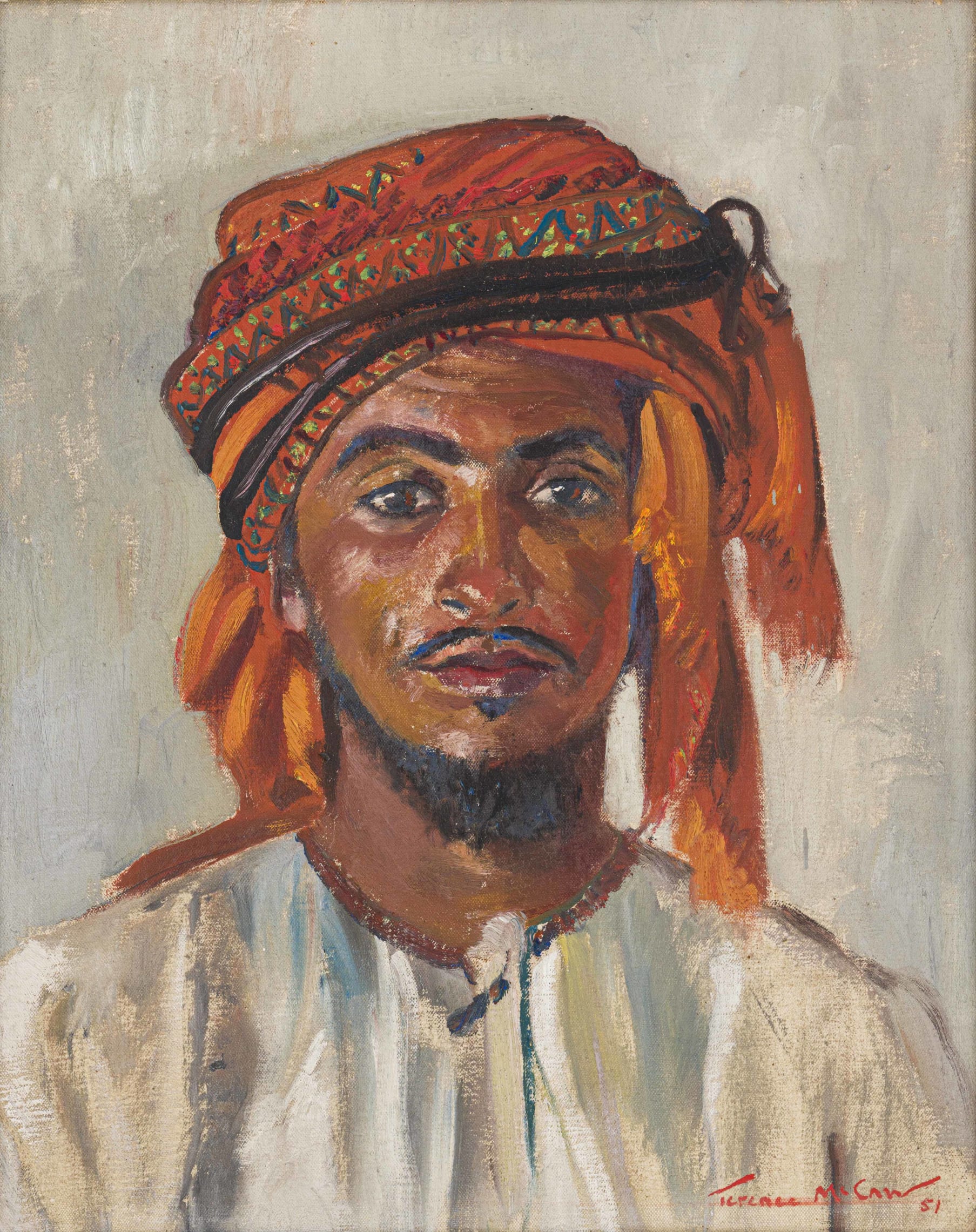
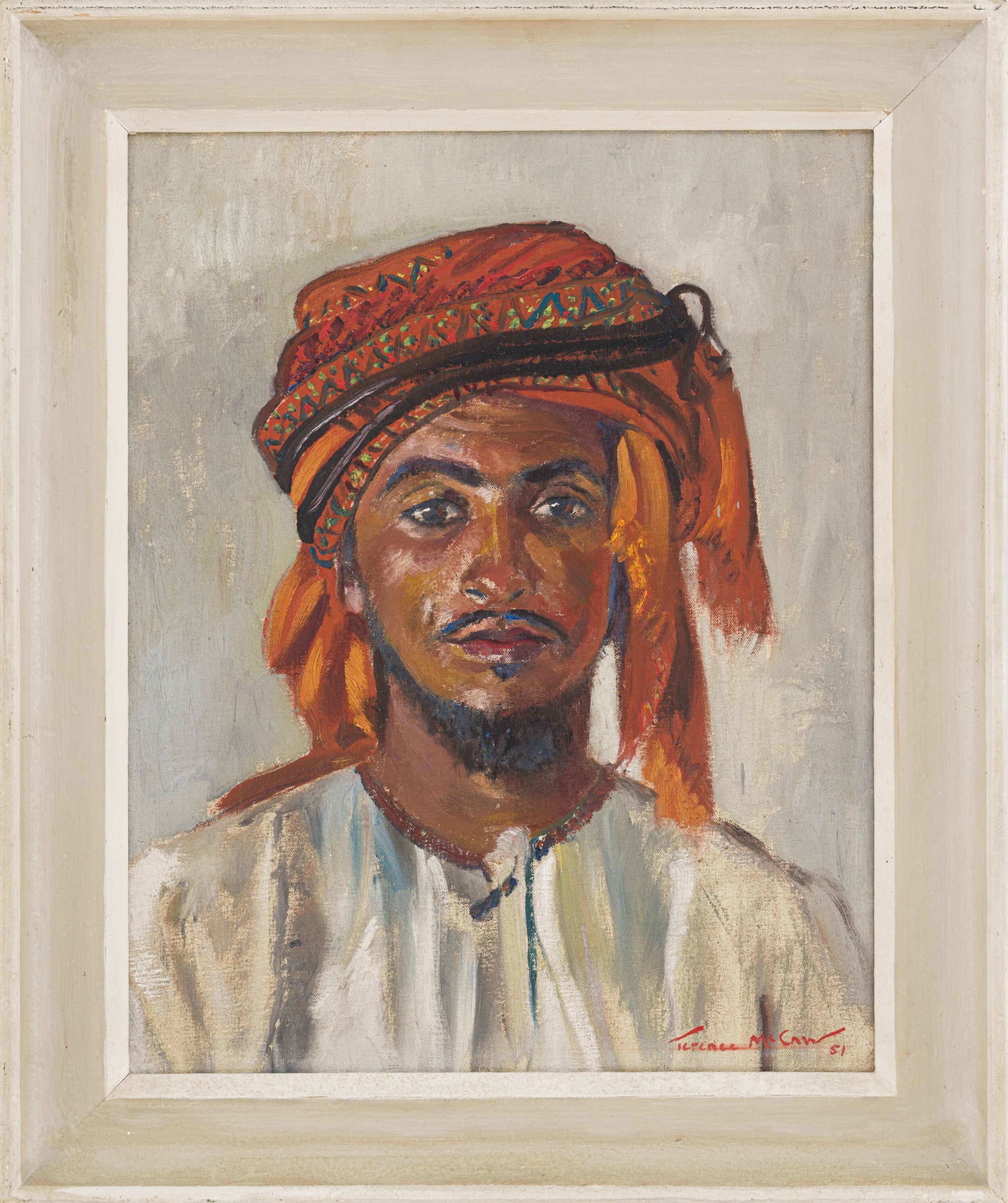
Ali Bin Salim ,
Provenance :
Exhibited :
Literature :
Notes : Terence McCaw, a distinguished South African war artist, made a notable entry into the South African 'New Group' of artists in 1937. Renowned for his distinctive post-impressionist style landscape paintings, McCaw's work contributed significantly to the Cape Impressionist painters' movement. The present two lots, the portraits of Ali Bin Salim and Sheik Mahamed of Kuwait differ from his usual oeuvre. In the early 1950s, McCaw embarked on an intriguing journey to Zanzibar, spending a year in the captivating locale. While historical records and exhibitions remain sparse regarding his activities from the early 1950s, these two exquisite paintings dated from 1951 surfaced from that era. As there is no substantiated evidence of McCaw venturing to Kuwait and, given the time frame, it is reasonable to suggest that these artworks were crafted during his Zanzibar sojourn. While Irma Stern is well recognised for the portraits she produced during her two visits to Zanzibar in 1939 and 1945 capturing the ethnic diversity, it would seem that McCaw’s artistic prowess also found inspiration in a similar place as Zanzibar was home to many elite families. In the portrait of Sheik Mahamed of Kuwait the sitter’s authority is emphasised by the garments he wears as well as the two swords, one in his belt and the other which he holds firmly in his right hand. Swords are traditionally seen as symbols of honour. The portrait of Ali Bin Salim, his attire of the orange kufiyah and white kurta don’t obviously indicate nobility but the subject is painted with dignity and importance. Strong blues and oranges are used in the face and the painterly style is reminiscent of post-impressionist artist and influence on McCaw, Paul Cezanne.
Condition_report :