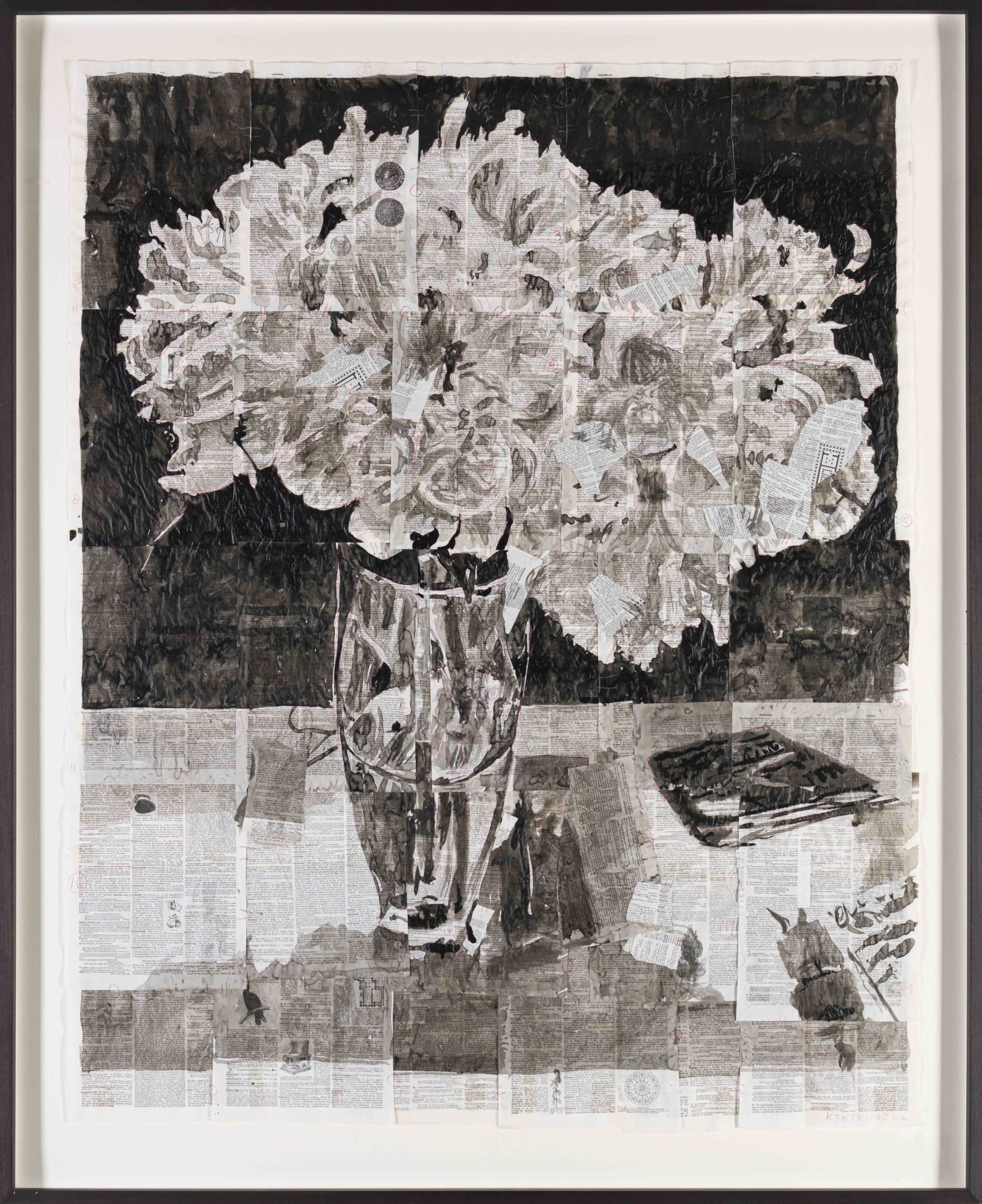
Peonies With Book ,2012
Provenance : [Propriété non datée]
- Goodman Gallery
Exhibited : More Sweetly Play the Dance, MUDAM, Luxembourg, 13 February 2021 to 30 August 2021. William Kentridge, Why Should I Hesitate: Putting Drawings to Work, Deichtorhallen, Hamburg, 23 October 2020 to 1 August 2021. William Kentridge, Why Should I Hesitate: Putting Drawings to Work, Zeitz MOCAA and Norval Foundation, Cape Town, 24 August 2019 to 23 March 2020.
Literature : William Kentridge (2019) Why Should I Hesitate: Putting Drawings to Work, Cape Town: Koenig Books, published to accompany the artist's exhibitions at Norval Foundation and Zeitz MOCAA, 24 August 2019 to 23 March 2020, illustrated on page 337.
Notes : Flowers feature periodically in the work of William Kentridge, fulfilling an allegorical role in his oeuvre. The image of a single stem iris, for example, was the first to appear, in an operatic work, Il Ritorno d’Ulisse (1998). The story told in the opera is that of the larger-than life character from Homer’s Iliad, Ulysses, on his return from the ten-year Trojan War, and another ten years of finding his way home to his wife, Penelope. Kentridge devised a highly innovative design for the opera: centre stage was semi-circled by a very steep, stepped anatomy-theatre-like structure on which the chorus and soloists were positioned. They overlooked the ‘anatomical dissection’ of the main character, Ulysses, lying prostrate on an old metal gurney from a Joburg hospital. The drawings projected against the back wall represented Ulysses’ subconscious. The drawings reflect the character’s inner conflict. The interior struggle is visualised by a set of drawings, which include x-rays, cross-sections of the brain, and sonar scans. These conflicts are ameliorated to some extent by the sprouting plant life which suggests rejuvenation and rebirth taking place. Out of drawings of Ulysses’ brain scans and cross-sections of his heart, grows an iris, symbolising Penelope. The peonies in the present lot, flamboyantly arranged in a composition with book, were exhibited as part of a bigger group of large-scale still-lifes made especially for one exhibition hall in the Zeitz Museum of Contemporary African Art retrospective of Kentridge works in 2019, the so-called Reading Room, replete with large tables and amply stocked bookshelves, all in the imposing presence of these wonderful still-life drawings. Peonies generally symbolise love, romance, honour, happiness, wealth, and beauty, and are traditionally given on special occasions to express best wishes and joy. The book on the table adds associations of knowledge and, given the fact that it is closed, mystery as well. Kentridge first included flower pieces and arrangements in the dramatic performance, Notes Towards A Model Opera (2011) in which these comingle with images of the Cultural Revolution in China in the 1960s. Typical of Kentridge’s artistic practice, these images often dissolve or morph into other reconstructed images, often with aphorisms written over them. Apart from the exotic peony, Kentridge also uses many indigenous flowers such as the arum lily, growing in his suburban garden in Johannesburg, in his flower pieces. These bunches of flowers he then stuffs into make-shift glass containers, such as Consol canned fruit bottles. One is reminded of the exuding sensibility of Eduard Manet still-lifes.