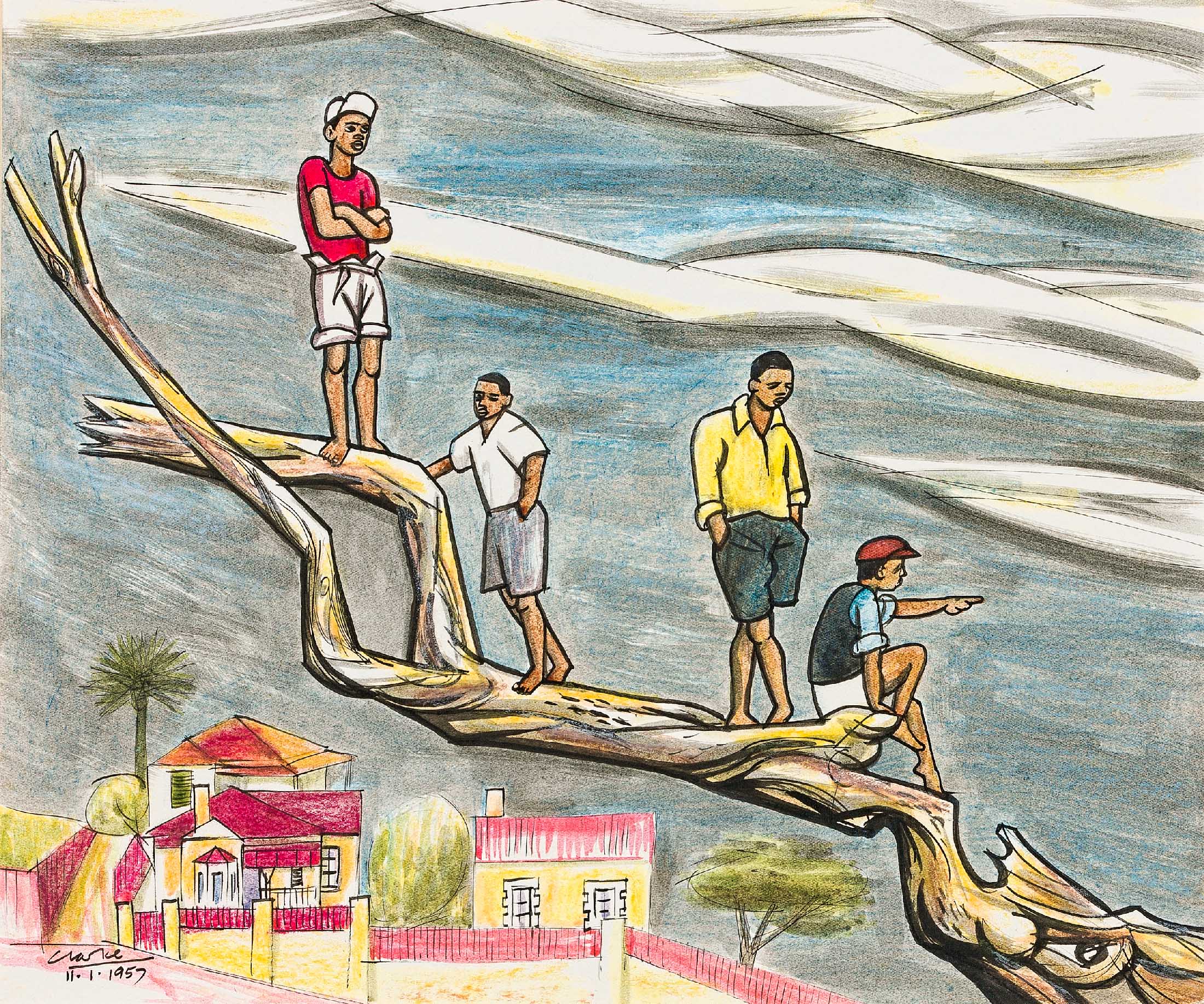
Fallen Tree ,1957
Provenance :
Exhibited :
Literature :
Notes : The year before he made this work, Peter Clarke made the momentous decision to abandon his job as a dock worker in Simonstown and become a full-time professional artist.1 “To start this new period in his life, Clarke went to Tesselaarsdal, near Caledon in the Overberg district, for three or four months at the end of 1956,”2 note Philippa Hobbs and Elizabeth Rankin, the authors of the monograph, Listening to Distant Thunder, that accompanied his major retrospective held at the Standard Bank Gallery in 2011. “He was to return there every spring from 1956 to 1960.”3
They quote Elsa Miles, who said: “Tesselaarsdal is Peter Clarke’s Pont-Aven”4 comparing Clarke with Gauguin. The rural setting was “an inspiration for his new career”5 and “seems to have been a place whose mood Clarke could reach imaginatively and relive at will”6 and to which he would return as a “creative refuge”7 later in his career.
During this early phase of his career, Clarke can be seen to experiment with many of the ideas that were to inform his later work, such as the faceted shapes of the cloud in this work, which presage the modernist-influenced faceted interlocking shapes that he employed in the early to mid-60s when he began painting scenes of Tesselaarsdal again.
The figures are typical of his interest “in capturing figures … in a variety of poses and different angles, using a simple contour”.8 The graphically contoured figures record “empathetically, and with dignity, the communities in which [he] lived and worked”.9 Hobbs and Rankin also note that “while Clarke rarely creates individualised portraits, his figures are not devoid of the dignity of self-will, whatever their setting.”10
Even the specific motif of the dead tree would reappear a decade or more later in Clarke’s most important works, such as Listening to Distant Thunder – after which his retrospective and the monograph was named – although it would become “a dispiriting symbol that recurs in many works”.11
Clarke’s essential humanism is evident in the self-contained figures preoccupied with something beyond the frame of the image.
1 Philippa Hobbs and Elizabeth Rankin (2011) Listening to Distant Thunder: The Art of Peter Clarke, Johannesburg: The Standard Bank of South Africa. Page 51.
2 Ibid.
3 Ibid. Page 53
4 Ibid.
5 Ibid.
6 Ibid. Page 105
7 Ibid.
8 Ibid.
9 Ibid. Page 75
10
11 Ibid. Page 112
Condition_report :