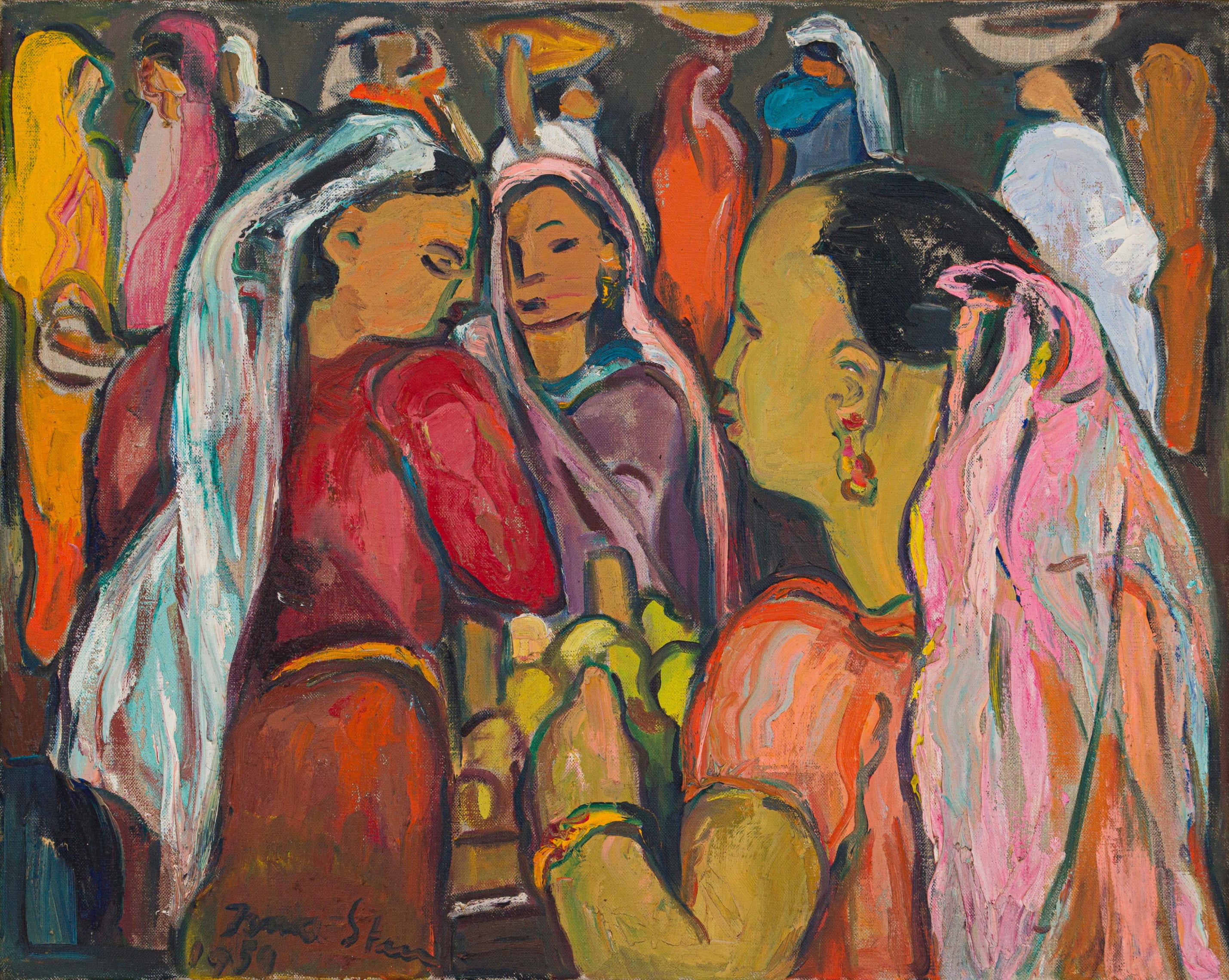
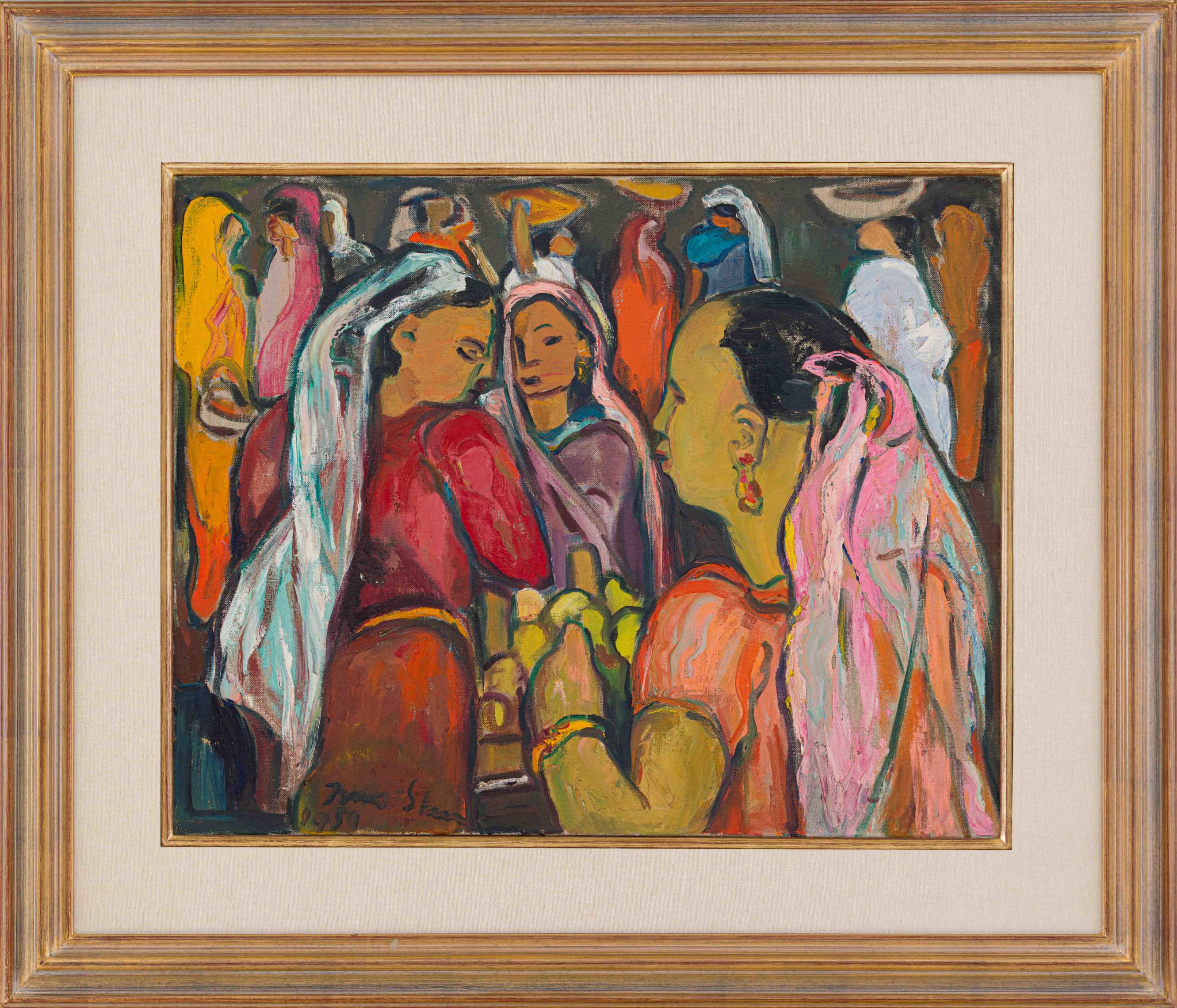
Indian Women ,1959
Exhibited : Expressions of a Journey Irma Stern, Standard Bank Gallery, 2003.
Literature : Wilhelm van Rensburg (ed) (2003) Expressions of a Journey, Standard Bank Gallery, Cape Town: Chameleon Press, illustrated in colour on page 118.
Notes : For Stern, Islam was exotic. The Cape Malays first introduced her to Islam and her fascination grew when she visited Zanzibar. Many of her portraits of Malay and Arab people emphasise sensuality and perpetuate the western belief in oriental languor and occidental energy. Arab Youth (1945) and Zanzibar Woman (1947) describe youthful sexuality and they also reinforce social and cultural norms about masculinity and femininity.
‘Although Stern’s portraits of Malays and Arabs describe cultural characteristics, she responds to the visual impact of her models. Her studies of women depict the sensuous interplay of warm flesh tones, dark glossy hair, rhythmic bodies, and brightly coloured and patterned cloth. The women are almost invariably posed against neutral grounds that serve as a foil for the hues of their clothing.’ 1
It was especially the customs associated with Malay weddings that interested Irma Stern. She painted many scenes depicting various practices regarding this auspicious cultural event. The present lot is no exception: it depicts the custom of the bride visiting relatives over the couple of days leading up to the wedding, each day and each visit dressing up in a different colour dress. The following description of a Malay wedding emphasises the picturesqueness of this custom: ‘The bride had four changes of gown. At first she wore silver grey, then green, with green veils and a highly jewelled and gilded headdress [the Medora] which is typically Malayan. Her third appearance was in glorious pink and gold draperies, with a floating pink veil and, finally, she was in the traditional white of brides. This gown was richly traced in gold and her headdress was of gold and white. With each dress she wore a long train.’2 The elegance, passivity and modesty usually associated with Stern’s portraits of veiled Malay and Arab women, gives way to exuberant joy suggested in the dynamic movement of the group of brightly clad women visiting friends and relatives on the day of the wedding, depicted in the present lot.
1 Marion Arnold (1995) Irma Stern: A Feast for the Eye. Cape Town: Fernwood Press, page 102.2 Cape Times, 28 June 1937. Quotes in I.D. du Plessis (1972) The Cape Malays: History, religion, traditions, folk tales, the Malay Quarter. Cape Town: A.A. Balkema, page 17.