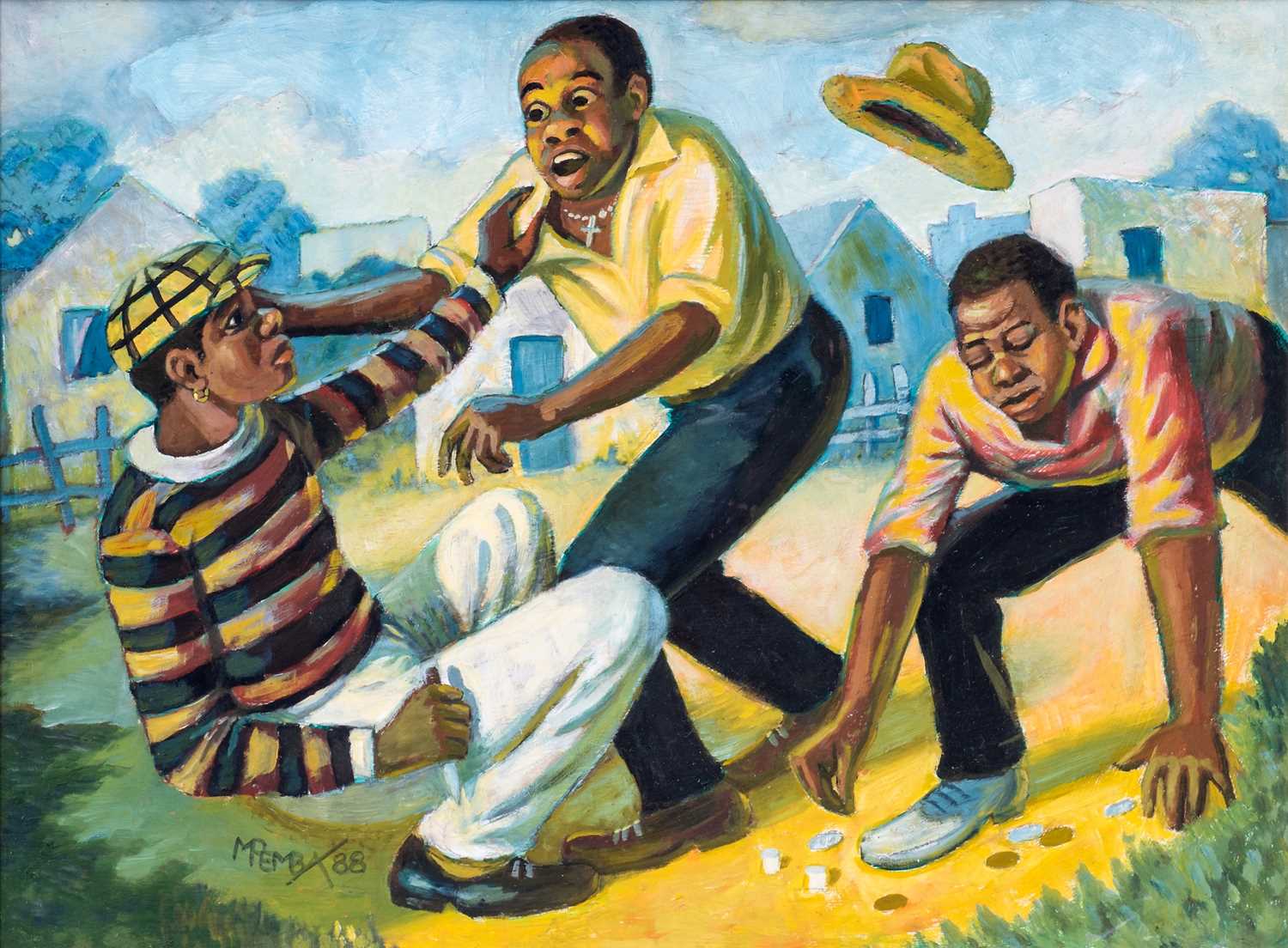
The Quarrel ,1988
Herkunft : [Propriété non datée]
- Campbell Smith collection
Exhibited : Iziko South African National Gallery, Cape Town, George Milwa Mnyaluza Pemba: Retrospective Exhibition, 1996 (catalogue no. 109)
Literature : Proud, H. (ed.). (2006). Revisions: Expanding the Narrative of South African Art: The Campbell Smith Collection. Pretoria: Unisa Press, illustrated in colour plate 417, p.356.; Hudleston, S. (1996). Against All Odds, George Pemba: His Life and Work. Johannesburg: Jonathan Ball Publishers, illustrated in black and white on p.74.
Anmerkung : Working in relative isolation in the Eastern Cape over a career that spanned some seven decades, George Pemba’s paintings reflect his complex assimilation via books and reproductions of the narrative traditions of the European Old Masters and 19th century Realism, as well as the formal innovations of French Impressionism and Post-Impressionism. From the later 1940s onwards, as he gradually abandoned his academic watercolour painting technique in favour of oil, he applied these different traditions of pictorial representation with greater vigour to a variety of subjects, ranging from portraiture to landscape, as well ‘genre’ scenes of ‘township’ life and reconstructed historical narratives.
Painted some twelve years apart, Pemba’s Nongqawuse (The girl who killed to save) (1976) and The Quarrel (1988) exemplify the last of these aforementioned subject categories. The mood in these paintings traverses the dramatic and even the melodramatic. In them, Pemba makes characteristic use of the vocabulary of 19th century European narrative painting, with its emphasis on gesture and exaggerated expression to generate a response in the viewer.
The Quarrel is one of many of Pemba’s lively genre scenes of community life that reflects something of the traditional moralising intent of much 19th century European painting. The immediacy of the violent physical assault and robbery underway between the three protagonists in Pemba’s rendering, leaves the viewer to ponder varied questions. Who of the role-players might be the real victim and who the perpetrator? What situation might have precipitated this violence? Implicit to the meaning of this work, is the ideal that physical violencein human societal relations ought not to occur.
On the other hand, Nongqawuse (The girl who killed to save), is an imagined reconstruction of an historical event. It is the most successful, expansive and important of all of Pemba’s iterations of this key scene from the suicidal ‘cattlekilling movement’ in the history of his own Xhosa people. A number of smaller versions of this subject were painted by Pemba, notably The Dream (1989) which is in the collection of the South African National Gallery in Cape Town.
The tragedy, precipitated by the supposed visions of a 15 year-old girl named Nongqawuse, led to the death, famine and ultimate colonial subjugation of the Xhosa people between 1856 and 1858. Obviously well-versed in the details of this historical event, Pemba had earlier written a musical play on this very same theme, based on H.I.E. Dhlomo’s drama The Girl Who Killed to Save (1935).
In 1856, Nongqawuse and a friend went to visit her uncle Mhlakaza’s crops in fields near the mouth of the Gxarha River. When she returned, Nongqawuse told her uncle that there she had encountered several ancestral spirits. These spirits, she claimed, had told her that the Xhosa nation should destroy all of their crops and their cattle as a prophetic precondition for a miraculous renewal of Xhosa agricultural prosperity, the resurrection of the dead and the annihilation of the European settlers. Nongqawuse’s uncle, Mhlakaza, did not believe her story at first, but when she accurately described the appearance of one of the spirits as his dead diviner-brother Mhalakaza, he was finally convinced. Mhlakaza conveyed news of the prophecy to the Xhosa King Sarili and his Gcaleka clan. This caused a cattle-killing frenzy that ultimately spread and aected the whole of the Xhosa nation. Between 300,000 and 400,000 head of cattle were destroyed with devastating and decimating consequences for the population.
With its panoramic crowd scene set against a broad landscape, Pemba’s painting Nongqawuse (The girl who killed to save) accurately features the key dramatis personae of this epic tragedy. Nongqawuse stands bare-breasted to the left of centre, with her arms outstretched, as if in a trance. The seated male figure in Xhosa diviners’ attire in the bottom left-hand corner is her uncle Mhlakaza. The placid stream which diagonally divides the foreground possibly represents the Gxarha River where she claimed to have experienced her visions. The idyllic landscape setting with its pastures and homesteads, including one of the cattle that was ultimately to be slaughtered, reflects Xhosa prosperity before the cataclysm. On the right hand side of the painting, raptly attentive to Nongqawuse’s prophecy, are seated the great Gcaleka chiefs of the Xhosa
kingdom. Wearing his royal regalia, with a crane feather, ceremonial beadwork and bearing his staff of choice in his hand, is seated King Sahrili. Seated next to him in the bottom right-hand corner is Mhlataza, the guardian of Nongqawuse, who was also the Sahrili’s adviser. [1]
Hayden Proud
[1] I am grateful to Carol Kaufmann for her assistance in identifying the key historical figures in this painting
via their traditional apparel and beadwork.
Condition_report :