Still Life With Vessels And Fruit On A Table ,
Herkunft :
Exhibited :
Literature :
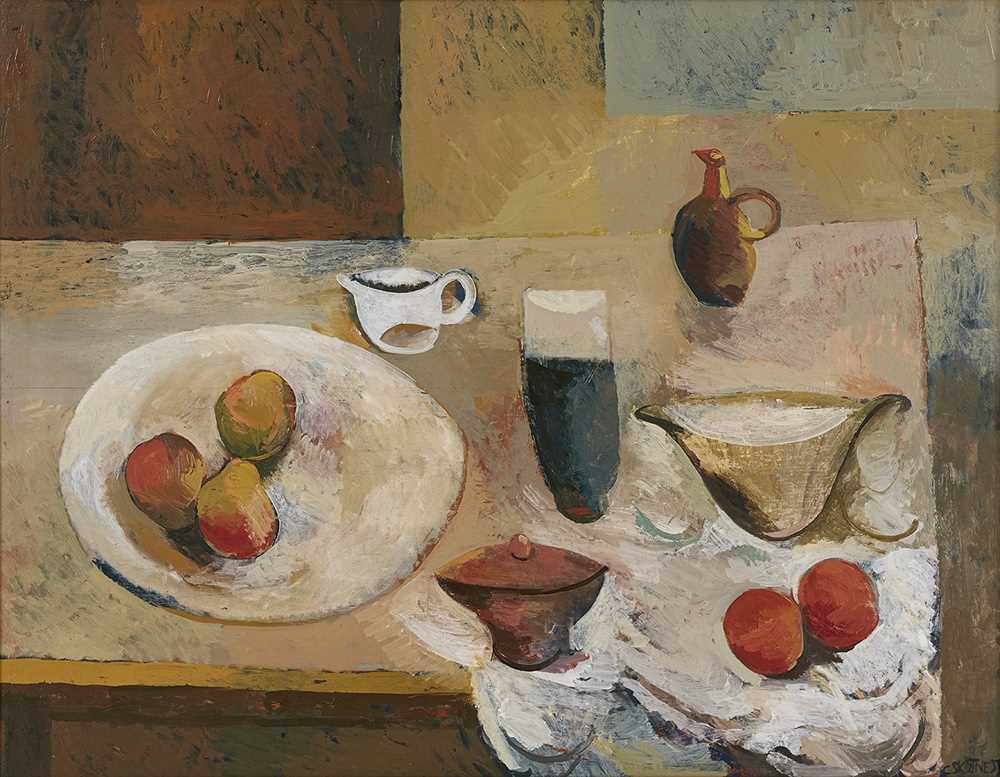
Anmerkung : This still life demonstrates unequivocally how Cecil Skotnes’s relocation to Cape Town in 1978 impacted on his artistic approach. The experience of Cape Town produced a radical shift in his style away from the linear, graphic quality of the African-inspired iconography he had developed in Johannesburg through his association with fellow artists of the Amadlozi Group.
Art critic, Neville Dubow, in an interview with the artist, maintained: “You have rediscovered yourself as a painter in your Cape Town years” going on to assert “there is an optimism in the work, a rediscovered certainty of touch. The simple joy – not a term one has call to use all that often – in the act of painting seems to have resurfaced. And that is reflected in the way the surfaces glow in their colour and tonal range” (Dubow 1996: 115-116)
Skotnes readily admitted to Dubow that the quality of Cape light had affected his new approach. It is apparent in this still life which is infused with soft light. The table is laden with the evidence of a good meal which Cecil and Thelma often shared with family, friends and fellow artists. Widely admired for their generosity of spirit, they often hosted dinners and were reciprocally entertained. Still life paintings such as these are evidence not only of their hospitality but of Skotnes’s mastery of the medium.
On the left a large plate laden with fruit balances a composition in which a decanter, a carafe, a jug, a ceramic lidded-dish and an over-flowing bowl are distributed across the table. Its hard edge is softened with a white cloth on which nestle two ripe tomatoes. The background, organised into abstract shapes, is reminiscent of the compositions of Douglas Portway, under whom Skotnes originally trained as a painter. It’s interesting to note how both artists developed a painterly lyricism through their poetic restructuring of observed reality.
Emma Bedford
Condition_report :