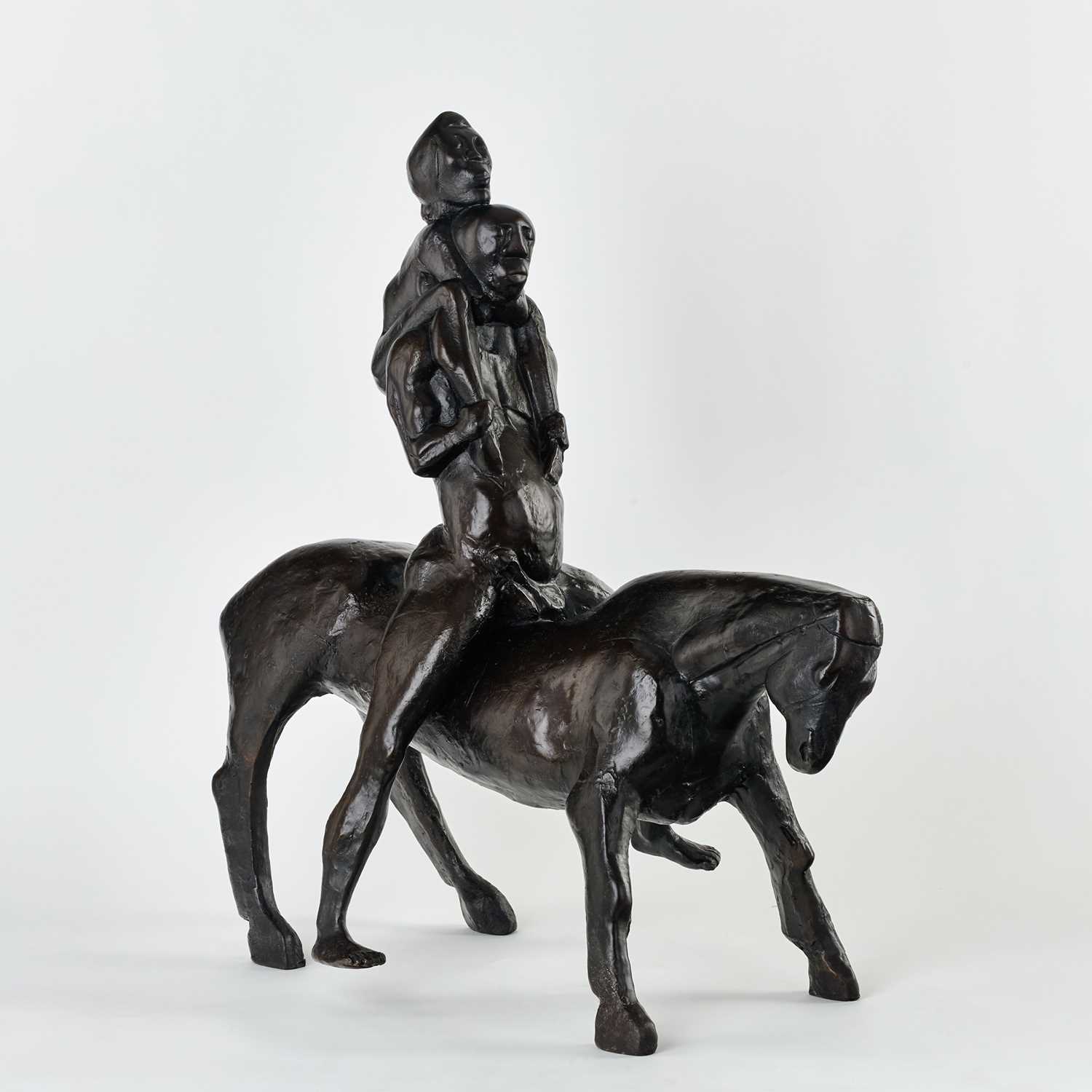
Horse Rider
Herkunft : Gallery Momo, Johannesburg.
Anmerkung : Zwelidumile Jeremiah Mgxaji, commonly known as Dumile Feni (1942-1991), was a former anti-apartheid activist, visual artist, and filmmaker born in Worcester, a small town outside Cape Town.
Even though he was born into a relatively comfortable family (in the context of racial segregation), after his parents died, the sickly and orphaned teenage Dumile and his siblings fell on hard times and yet he still managed to find refuge in art. It would be in the fraught and politically sterilised context of 1960s Johannesburg that Dumile’s highly prized evocative drawings and sculptures – that captured both the liberal art establishment and his fellow artists – and his name came to critical prominence.
His unique and forceful pictorial style seized the sombre mood of the time with unapologetic vigour. Rather than resigning to the afflictions of the day, Dumile’s art asserted a visual parlance through which the ravaged human-cum-animalised body of the oppressed regained a social agency. This animal-man idiomatic reference in Dumile’s oeuvre is a thematically varied subject matter the artist has explored almost throughout his career and is in this case done through the bronze sculpture Horse Rider.
Horse Rider depicts a father and child duo on horse back. Riding here takes on a double meaning: that is, the man and child riding the horse and the child riding the man. Though riding might for others be a pleasurable pastime, in Horse Rider Dumile seems to be reminding us of the unthought, and indeed cumulative, effects our pleasures might have on those species reduced to “beasts of burden.” Although not necessarily reducing humans to animals, even when an uncanny animal/man profile can be detected, it seems that Dumile’s analogy is making us sensitive enough to a moral degeneration and the snowballing of practices of exploitation in our ecosystem.
Quite opposite to this however, are the works The Duo (lot 21) and Couple with Umbrella (lot 20) – from his famous Nina series (based on Dumile’s observations and memorialisations of his relationship with U.S. curator and friend Nina Bergmann) – which retain a more sensuous and deliberately light-hearted comportment about them.