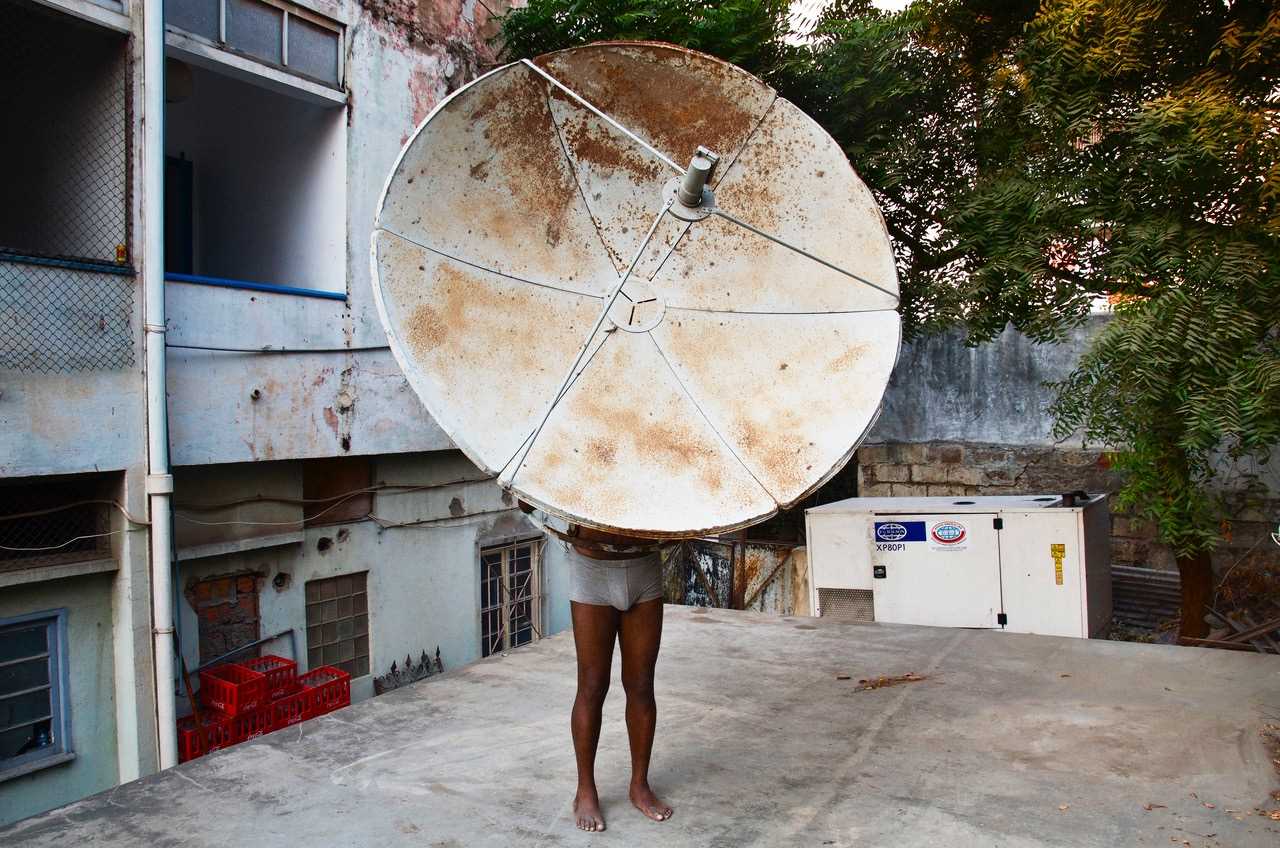
Objet Trouvé #1 ,2016
Herkunft :
Exhibited :
Literature :
Anmerkung : Kiluanji Kia Henda is an autodidact for whom a profound springboard into this was growing up in a household of photography enthusiasts. His conceptual edge was sharpened by immersing himself into music, avant-garde theater and collaborating with a collective of emerging artists in Luanda’s art scene. In his practice, he explores photography, video, performance, installation and object-sculpture to materialise fictitious narratives, dislocating the facts to dierent temporalities and contexts. Select solo exhibitions include Something Happened on the Way to Heaven, Museo di Arte di Nuoro, Nuoro (2020); The Isle of Venus at Museum of Leuven, Leuven (2020); A City Called Mirage at the International Studio and Curatorial Program in New York (2017); In the Days of a Dark Safari at Galeria Filomena Soares, Lisbon, and Goodman Gallery, Cape Town (2017); and Self-Portrait As A White Man at Galleria Fonti, Naples (2010). Kia Henda has participated in numerous international group exhibitions, including exhibitions at the Barbican Art Center, London (2020); Migros Museum, Zurich (2020); Zeitz MOCAA, Cape Town (2019); Tate Modern, London (2019); MAAT, Lisbon (2018); Centre Georges Pompidou, Paris (2016); the National Museum of African Art - Smithsonian Institution, Washington (2015); and the Guggenheim Museum, Bilbao (2015). His work was shown at the Gwangju Biennale, Gwangju (2018); Bergen Assembly, Bergen (2013); São Paulo Biennale, São Paulo (2010); Venice Biennale, Venice (2007); and the Luanda Triennale, Luanda (2007). In 2017, he received the Frieze Artist Award. He was awarded Angola’s National Culture and Arts Award in 2012. His work is held in private and institutional collections, including Tate Modern, London; the Museum of Modern Art, Warsaw; Centre Pompidou, Paris; FRAC Grand Large – Hauts-de-France, Dunkerque; and Pérez Art Museum, Miami. Objet Trouvé is a series of six portraits taken in the derelict area behind the Hotel Globo in central Luanda. They bring into the foreground found objects that conceal and divert attention away from the man behind them. However, the found object not only obstructs the gaze, of both the portrayed and the observer, but also reveals an extremely violent process – the thingification of the black man, who is repeatedly made an object: the object of his own work (as labour disconnected from that which he produces), the object of colonialism (which treats him as merchandise), the object of the object (as a being made a subject by the found object) and finally the object of the photograph (which turns him into the object consumed by the gaze). More than mere masks which cover and reveal possible identities, the found objects become replacements for missing heads. There is a series of myths in which a divine being, such as Ganesh in Indian culture and Oxaguian in the Yoruba culture, is born without a head or loses it and then makes use of a fantastical replacement. Here the found object re-emerges as a humiliation and hindrance through which the black man returns the gaze of those who observe him. However, in Objet Trouvé, the object protects the man portrayed from the observer’s gaze and presents the observer with a strangeness that induces a certain unease. Identity-erasing masks, replaced heads, torture devices, there is always a body/object which is first dreamed about – the synthesis of fears and desires – before being turned into reality, and a provocation. […] Finally, they are simpleobjects found in the street. Trivial objects which, through their dislocation in time and space in line with an entire mise en scène, are given new charm when subverted from their original functions. –
Lucas Parente
Condition_report :