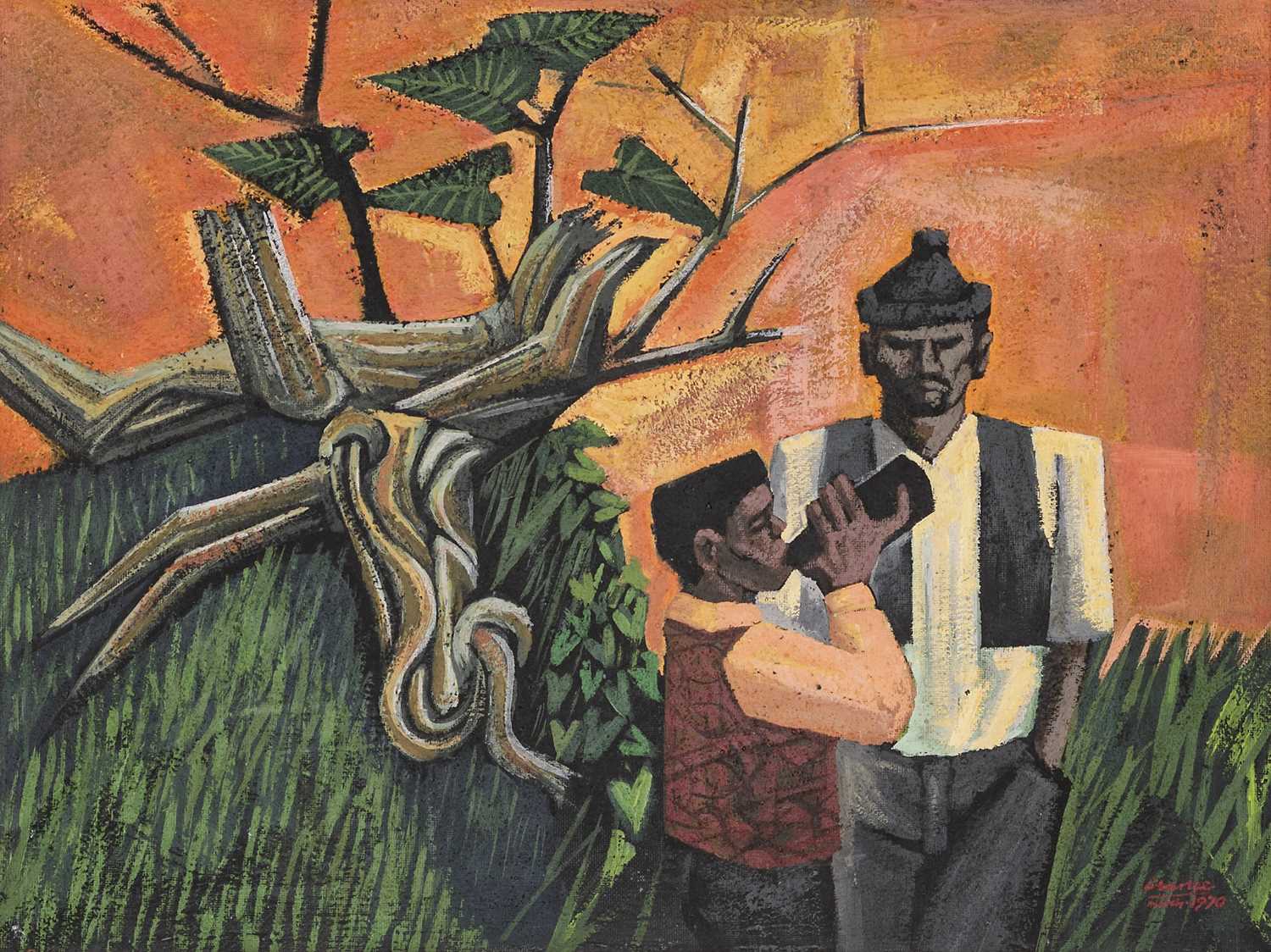
Dop ,1970
Herkunft :
Exhibited :
Literature :
Anmerkung : Peter Clarke holds a unique place in South African art both for his poignant insights into South African society and his vivid imagery. Printmaking classes at the Michaelis School of Fine Art in 1961 refined his graphic skills. And his attendance in 1962 at the Rijksakademie van beeldende kunsten in Amsterdam with funding from the Congress for Cultural Freedom in Paris, which was arranged through exiled South African writer Ezekiel Es’kia Mphahlele (with whom Clarke was acquainted through their work for Drum magazine), [1] provided additional artistic skills and confidence.By 1970, Clarke was an established painter and graphic artist, writer, poet, chronicler of his times and commentator on life. Nowhere is this multiplicity of skills and insights more poignant than in this painting, simply titled Dop. As any South African will know, ‘dop’ means ‘drink’: it is both a noun, describing an alcoholic beverage and it is also a verb – to drink. The word conjures images of gaiety, celebrations and shared pleasures. However, it also carries connotations of the dreaded ‘dop system’, a practice whereby workers, especially on farms, were paid in measures of alcohol.This is a rare subject in Clarke’s oeuvre, making it an exceptional work. Clarke was acutely attuned to the woes of ordinary people and particularly those against whom the apartheid system of racial division was cruellest. Images of suffering that confirm his great empathy for his fellow human beings include Die lang pad (1962) and Anxiety (1966).In this painting a youth is shown drinking from an unmarked bottle. Behind him stands an older figure—a man staring with disapproving looks or a manifestation of his conscience—as if to warn him against the pitfalls of alcohol consumption. Danger is echoed in the surrounding landscape with its thorny branches and red skies.
Emma Bedford
Condition_report :