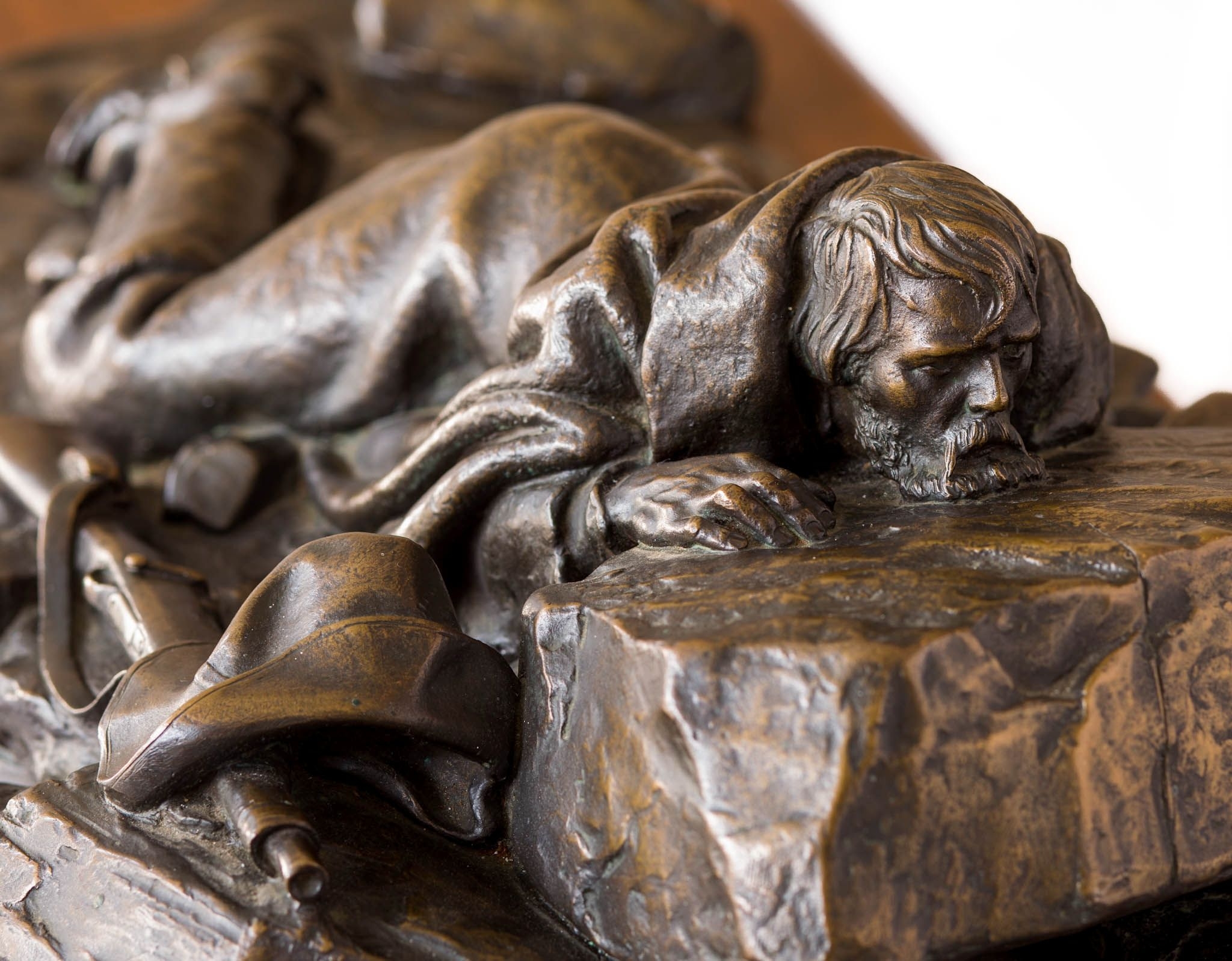
The Scout ,1910
Herkunft :
Exhibited :
Literature : Duffey, A.E., Anton van Wouw: The Smaller Works, Protea Book House, Pretoria, 2008, another cast from the edition illustrated on pages 84 and 85.
Anmerkung : Anton van Wouw immigrated to South Africa and settled in Pretoria in 1890. As a Dutch immigrant, he sympathised with the Boer cause and produced many iconic images that immortalise both the leadership and the ordinary people. His first commission came in 1896, from South African industrialist and financier, Sammy Marks, for the bronze sculpture of Paul Kruger that now stands in Pretoria’s Church Square.
The Scout (or Brandwag) is perfectly camouflaged for the guerrilla warfare which the boers initiated during the Second Boer War or Tweede Vryheidsoorlog to combat the might of the British forces ranked against them. Viewed from the other side of the rock, the fighter would be barely discernible. A blanket covers him, leaving only his head, hand and boots protruding. While the blanket serves as a useful disguise, in the hands of this consummate sculptor it becomes a clever device to minimise attention to superfluous details and focus all interest on the head and hand – the ultimate signifiers in this work. The boers, with power and numbers against them, fought a strategic war through ingenuity and skill.
Van Wouw, ever the master sculptor, knew how best to extract symbolic significance from every detail and gesture. With his hat removed to make him less conspicuous (and more vulnerable), the scout’s rifle lies within easy reach of his right hand. Van Wouw favoured modelling his subjects in clay and overseeing their casting at the best foundries in Italy such as the Massa Foundry in Rome in order to ensure the highest possible standards. As Professor A E Duffey points out, 'the best castings render the textural differences between the hard ground and soft blanket and highlight the fine detail of facial features, hands, boots and rifle mechanisms.'1
1 Duffey, A.E. Anton van Wouw: The Smaller Works, Protea Book House, Pretoria, 2008, page 85.
Condition_report :