David Goldblatt (1930-2019)
À propos du lot
n° 68
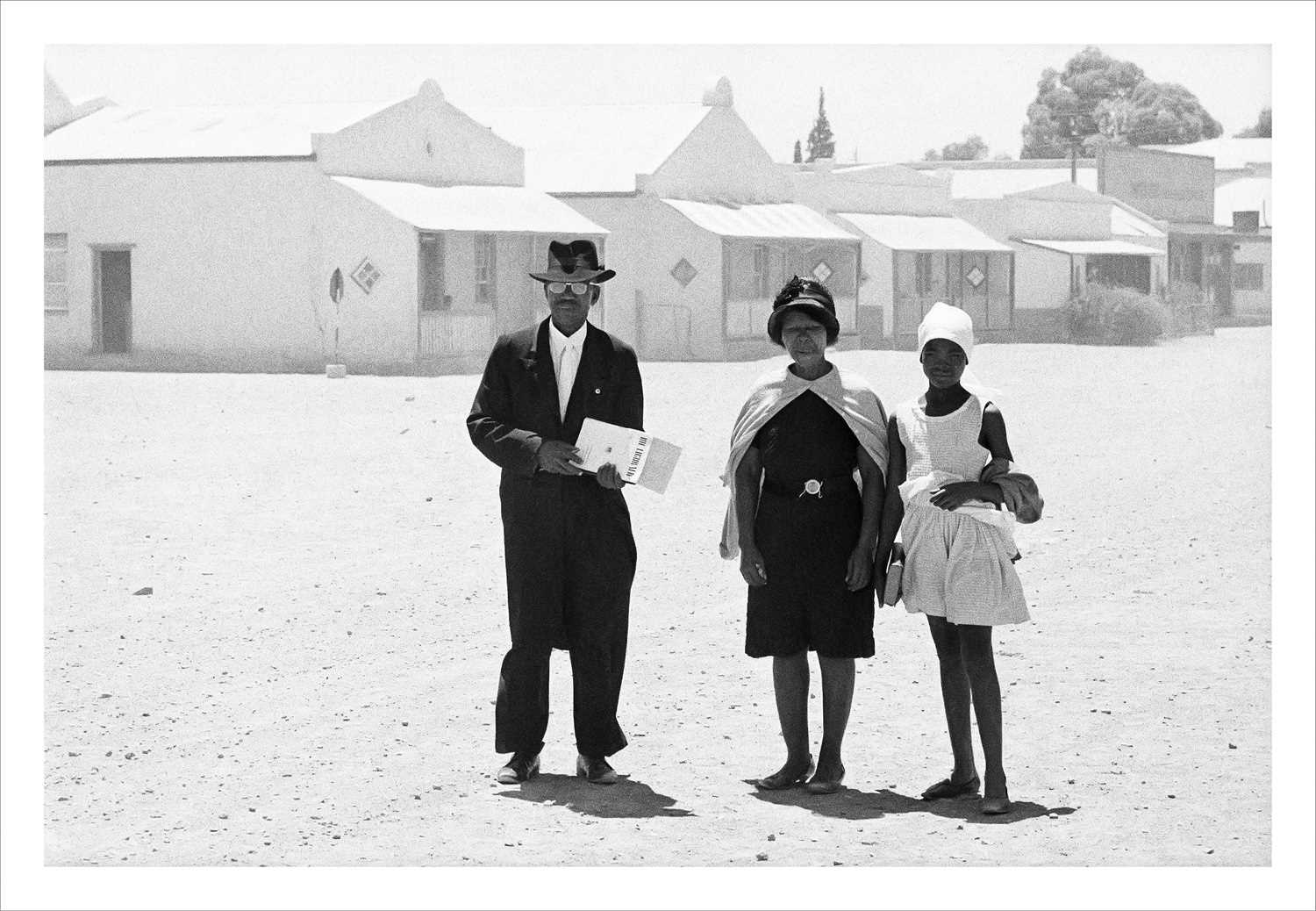
Elder of the Dutch Reformed Church walking home with his family after the Sunday service, Carnavon, Cape Province (Northern Cape), January 1968 ,1968
Medium: gelatin silver print
Dimensions :
Édition:
Signature: signed and dated in pencil on the reverse
Prix: 11 490.55 USD
🔓Accès libre sans carte bancaire.
Estimations(basse-haute) :
150000 ZAR-250000 ZAR
🔓Accès libre sans carte bancaire.
Aspire Art Auctions, Salle de vente
🔓Accès libre sans carte bancaire.
Titre de la vente : Modern & Contemporary Art
🔓Accès libre sans carte bancaire.
Date de la vente : 03/11/2019
🔓Accès libre sans carte bancaire.
Référence de l'enchère
: Live Sale
Détails
Provenance :
Exhibited :
Literature :
Notes : A highly controversial body of images at the time of its 1975 first edition photobook debut, the series Some Afrikaners Photographed was and remains an unflinching, dispassionate though not unsympathetic 20th century portrait of a South African community. During his lifetime, David Goldblatt maintained that the project was not intended as nor should it be considered a definitive or essentialised understanding of Afrikaner identity. Instead, “Goldblatt destabilises. He suggests porous definitions.”Though this image from the series (LOT X) stands alone as its own complete, autonomous work, Goldbaltt’s oblique and open-ended strategies shift into focus when juxtaposing this image with another from the series (figure 1). “Here the mirroring of the two images—in the symmetrical posing of the figures, the formal presentation, the repeated father/mother/daughter family group—draws them as much as the caption does into an inescapable alignment and dialogue that is fraught by the fact that one family is white, the other is coloured. Both elders are worthies in the Dutch Reformed Church—though not without qualification. What Goldblatt’s caption does not mention is that the coloured elder would have been the Nederduitse Gereformeerde Sendingkerk, the made-for-non-whites stepchild of the parent church. The coloured leader and his family would not have been allowed to attend services in the church of the white elder.”[2] The strength of this work (and indeed Goldblatt’s larger practice) is the subtlety of his persuasion: decisive conclusions or final pronouncements are left to the discretion of the viewer.
Kathryn Del Boccio
Condition_report :