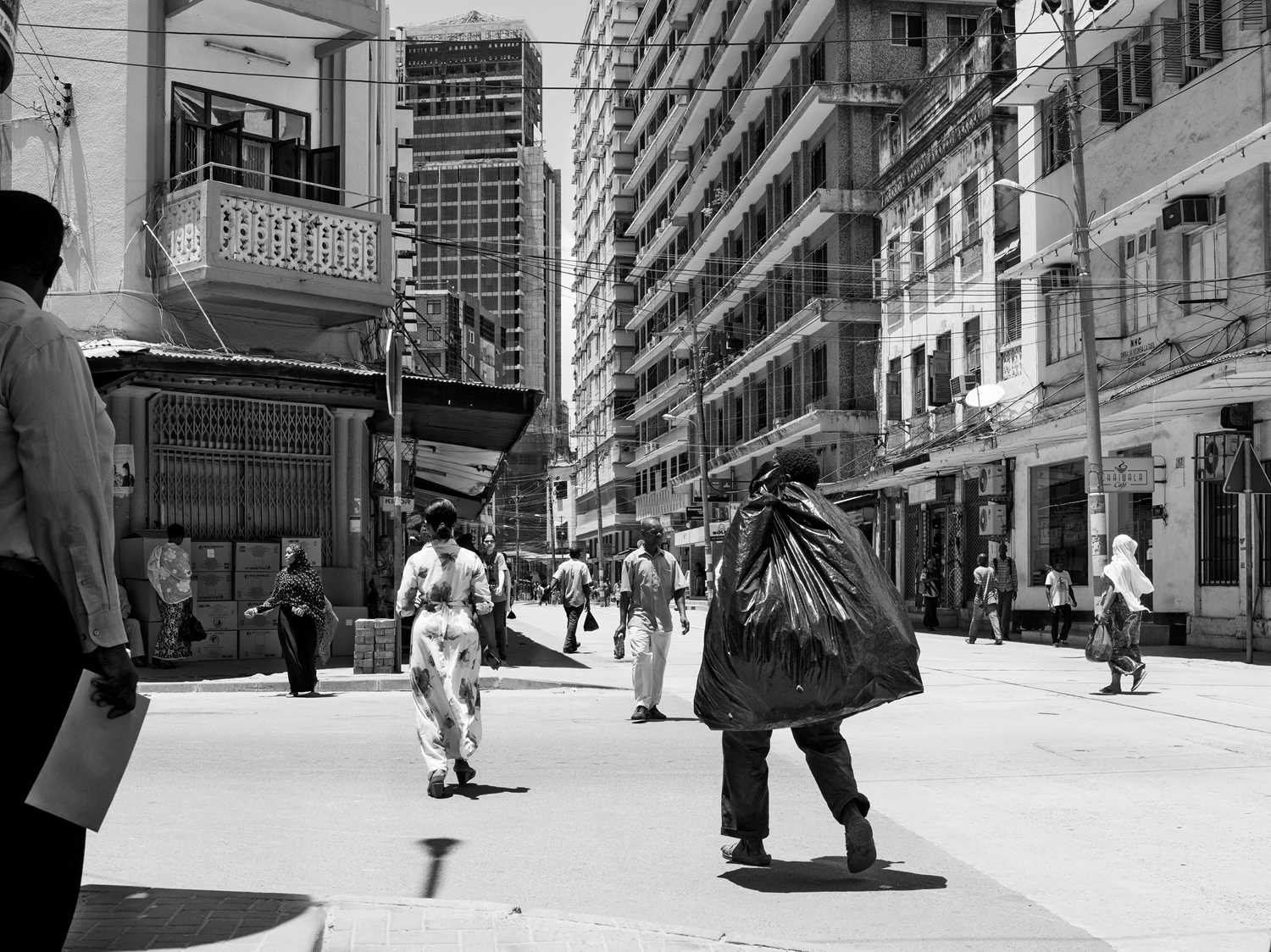
Dar es Salaam, 2017 (from the Dar es Salaam and Abidjan series) ,2017
Provenance :
Exhibited :
Literature :
Notes : Guy Tillim was born in Johannesburg and lives in Vermaaklikheid, South Africa. He started photographing professionally in 1986, working with the Afrapix collective until 1990. His work as a freelance photographer in South Africa for the local and foreign media included positions with Reuters between 1986 and 1988, and Agence France Presse in 1993 and 1994. Tillim has received many awards for his work, including the Prix Societe Civile des Auteurs Multimedia (SCAM) Roger Pic (2002); the Higas-hikawa Overseas Photographer Award (2003);the Daimler-Chrysler Award for South African photography (2004); the Leica Oskar Barnack Award (2005); the first Robert Gardner Fellowship in Photography from the Peabody Museum at Harvard University (2006); the Quai Branly Photography Residencies (2015); and the HCB Award (2017). He has had solo exhibitions at, among others, the Centre Photographique d’Île-de- France, Paris; Huis Marseille Museum of Photography, Amsterdam; Fondation Henri Cartier-Bresson, Paris; Museu Serralves, Porto; the Peabody Museum at Harvard University, Cambridge; FOAM Fotografiemuseum, Amsterdam; and the Museum of Contemporary Photography, Chicago. His work was included in Documenta 12 (2007), the São Paulo Biennial in (2006), and the touring exhibition Africa Remix (2004–7), presented at the Centre Pompidou in 2004. This work forms part of Guy Tillim’s solo exhibition Hotel Universo, shown for the first time in 2020 at Stevenson Cape Town. Moving away from the colour photography that has characterised his recent projects, Tillim returns to his archive and his darkroom to produce new black and white images for three bodies of work, each presented as a unique photobook. The book Dar es Salaam and Abidjan takes its cue from street photography and places emphasis on individuals. The pictured crowds engage in commerce, travel and other acts towards the fulfilment of needs, Tillim combines elements from dierent frames to create new scenes of urban life. […] I indulged a fantasy that, if you’ve ever been a photographer, I’m sure has crossed your mind: and that is to combine elements from dierent frames into one picture. I’ve spent years on street corners, and walking streets trying to convey just ordinary scenes, little daily events that happened by the billion. And yet, a part of me wanted to capture something out of the ordinary, or rather something so particularly ordinary that it had eortless grace and an eortless path to oblivion. Which was always so extremely di!cult and sometimes tortuous. You’d spend hours and days, and then hate yourself because you just couldn't do it, and photographers you admired were seemingly doing it all the time. So I constructed the images. Because I can. Because I wanted to see what they looked like. You note a little defensiveness in my tone there? My former profession of photojournalism disapproved of this kind of construction, saw it as disingenuous: a single moment should be able to be plucked out from its journey to oblivion and be consecrated as ‘something that happened’. I suppose I’m playing with time really. The scenes all happened, not in that sequence maybe, but with another throw of the dice, who knows? It’s a playful way of approaching something; I’m not saying I’ll do this all the time, or every time.
Condition_report :