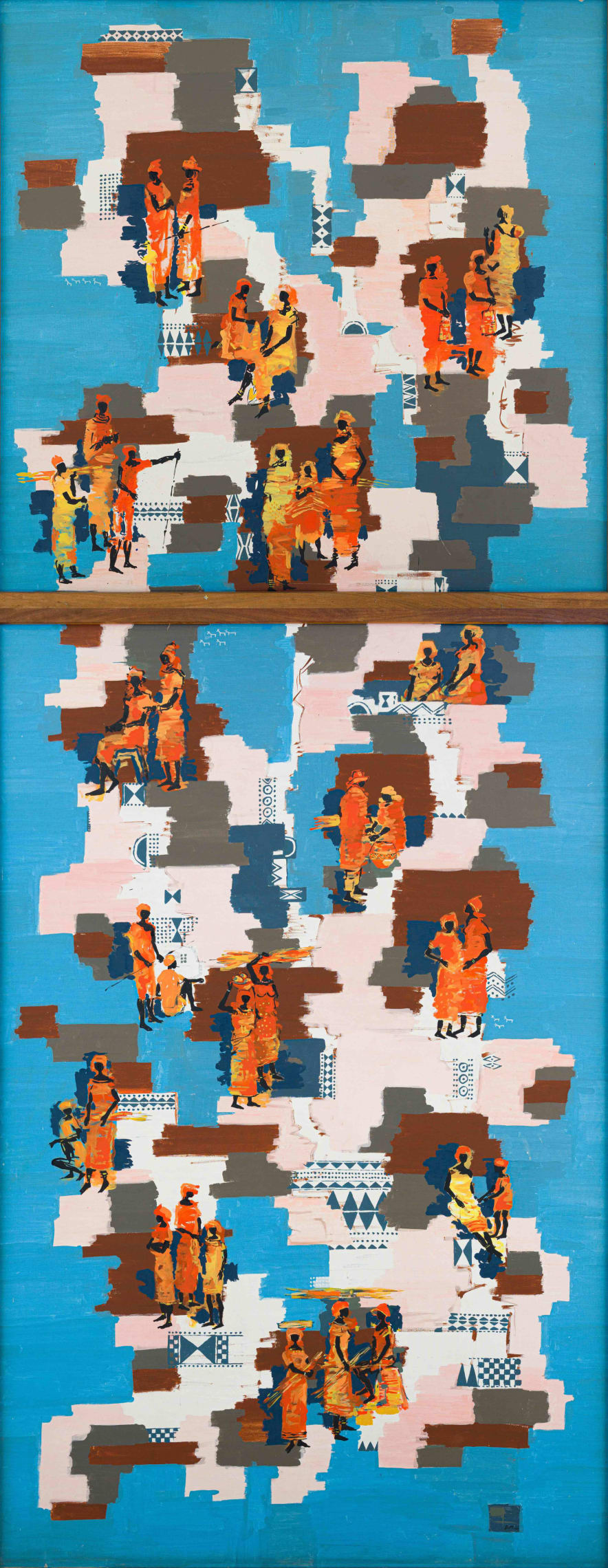
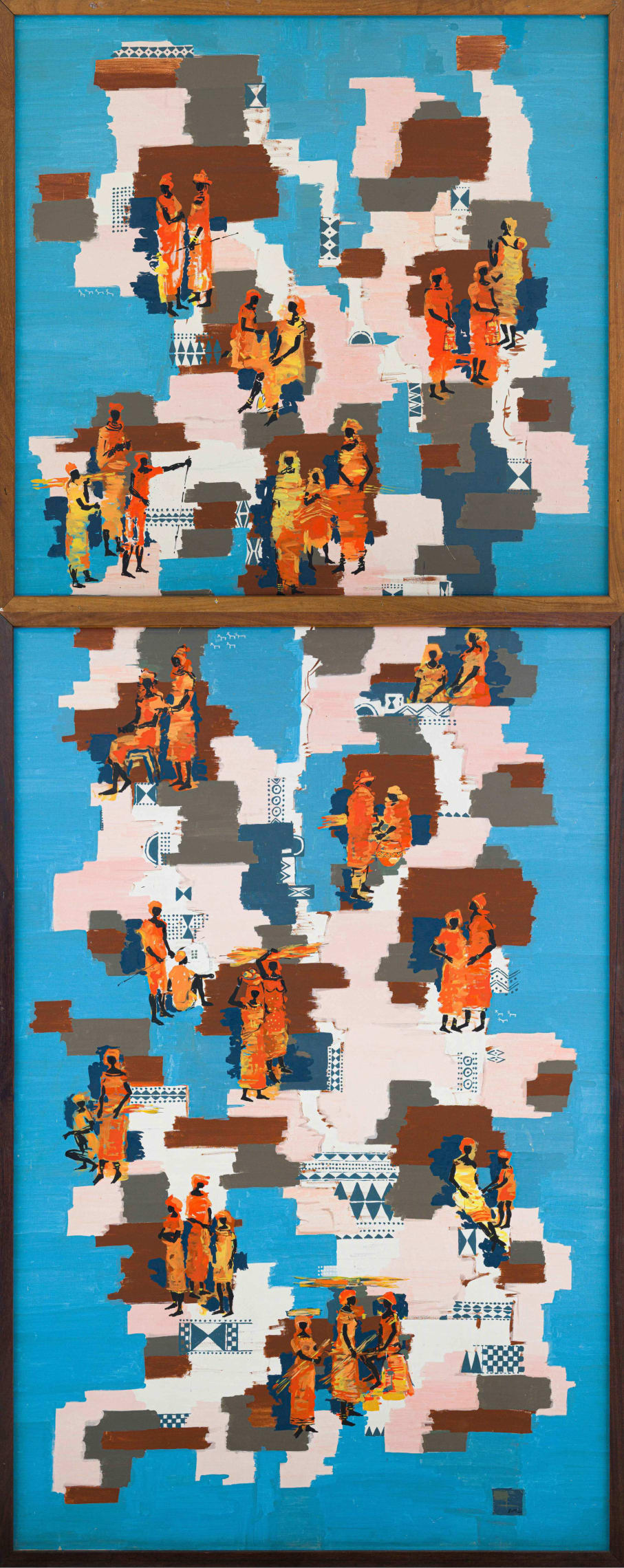
Spirit Of Africa ,
Provenienza :
Exhibited :
Literature :
Note : The late-1950s, early-1960 sees Walter Battiss coming to terms with the influence traditional African art, and especially San rock art has had on his own thinking and artistic practice. He deploys these on a rather unusually large scale: the Sanctuary mural for the Transvaal Administration building (1958-59), African Paradise (1960) and the present lot, The Spirit of Africa (c1960), a private commission for a modernist house in Kimberley. The Northern Provence had a special allure for Battiss, as this was the area where he stumbled upon the engraved signs on the flatbed rocks of the Lower Riet river near Douglas (close to Kimberley). These signs he viewed as a type of language, forming the basis of Battiss’ famous Fook alphabet he devised in the early-1970s. Similar signs are dotted all over the picture plane of the present lot. The rendering of the figure clusters, also dotted all over the picture plane, however, reminds of Battiss’ equally famous sgraffito technique: engraving figures with the back end of his paintbrush in thickly applied flat areas of paint, providing their silhouettes with a rather classical and sculptural sensibility.
‘We should accept the dual position of the South African artist’ says Battiss. ‘At one moment he is a European with Greek statues and Roman poets inhabiting the shades of his intellectual landscape; at another moment he is a man, surrounded by African forests, girdled by unending savannas where roam elephant and giraffes. The inner classic world of his education is one of a familiar security – it is a world of men with predictable situations, predictable ethics and predictable solutions. Its pleasures include literature, music, science, art and sport. It is the world that opens up the mysteries of matter, space and speed and an academic art that lends itself to landscapes, portraits and the human figure. But on the other side, hugging him like a rough uncomfortable goatskin, is unusual Africa: insecure, black and red in colour, volcanoes, lakes, droughts, floods, flames, men in conflict. And so it happens that the modern man holding his Virgil is thrown from his European chariot onto the African thorns. This desperately uncomfortable position is one the artist faces. He has to ask himself what he is and what he should do.
‘I was trying to find out that the art was before the Europeans came, take what I could find from it, change it and build on it. This was completely misunderstood. People thought that all I was doing was imitating the bushman or just extending Bushman art or prehistoric art but that was not what I was getting at at all. I think it is necessary to make it quite clear now that what I had recognized was that in all of us there is still some aspect of primitivism – the vestigial Adam. There is still some of the primitive man in all of us. I looked upon bushman art as just one form of art against a big background of all art in the world. 1
Esme Berman views Walter Battiss and Alexis Preller as the two main exponents in the quest for the spirit, the mystique if Africa 2, and the present lot attests to Battiss’ success in this regard.
1 Interview with the artist: ‘The Art of Walter Battiss’ Fontein, 1060, Volume 1 number 1.
2 Esme Berman (1074) The Story of South African Painting. Cape Town; A.A. Balkema, pages
Condition_report :