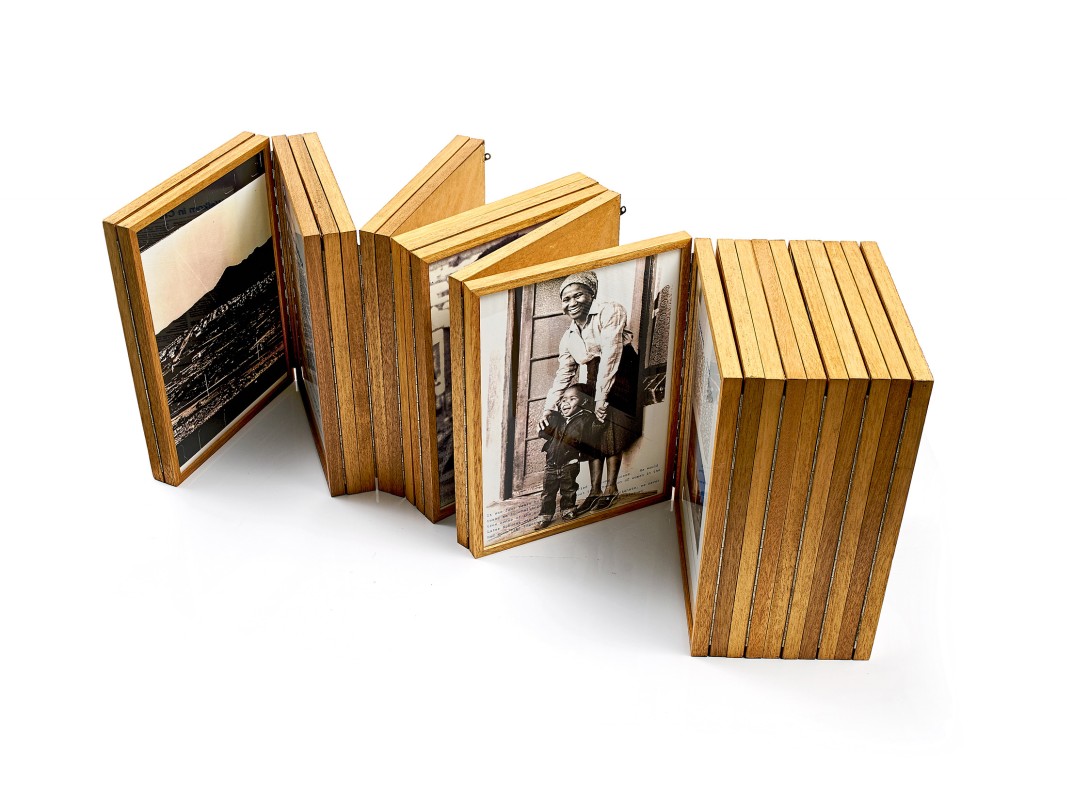
A Tale Of Two Cradocks ,1994
Provenienza :
Exhibited : South African National Gallery, Cape Town, Lines of Sight: Perspectives on South African Photography, 1999
Bamako Bienniale, Mali, Lines of Sight: Perspectives on South African Photography, 2001
Other examples from this edition:
Art First, London, Trackings, 19 April to 19 May 1994
Haus der Kulturen der Welt, Berlin, Colours: Kunst aus Südafrika, 24 May to 18 August 1996
Centre d'Art Contemporain, Brussels, Belgium, Sue Williamson, 24 April to 14 June 2003
International Center of Photography, New York, Rise and Fall of Apartheid: Photography and the Bureaucracy of Everyday Life, 14 September 2012 to 6 January, 2013
Gloucester Green, Regent's Park, London. Frieze Masters, 15 to19 October 2014
Literature : Other examples from this edition:
Alfons Hug and Sabine Vogel. (eds.) (1996) Colours: Kunst aus Südafrika, Berlin: Haus der Kulturen der Welt. Illustrated in colour on page 147.
Nicholas Dawes. (2003) Sue Williamson: Selected Works, Cape Town: Double Storey Books. Illustrated in colour on pages 64 and 65.
Okwui Enwezor and Rory Bester. (eds.) (2013) Rise and Fall of Apartheid: Photography and the Bureaucracy of Everyday Life, New York: International Center of Photography. Illustrated in colour on pages 330 and 331.
Mark Gevisser. (ed.) (2015) Sue Williamson: Life and Work, Torino: Skira. Illustrated in colour on page 89 to 93.
Note : Other examples from this edition in the Museum of Contemporary Art, San Diego, USA as well as major international private collections.
Mark Gevisser. (ed.) (2015) Sue Williamson: Life and Work, Torino: Skira. Page 88:
In 1989, Sue Williamson travelled to the small town of Cradock, in the Eastern Cape, to meet Nyameka, the widow of the charismatic schoolteacher and community leader Matthew Goniwe. Driving through the town on her way to Lingelihle, the black township adjoining Cradock, Williamson stopped to pick up the guide to the town at the local tourist centre.
She was struck by the fact that while the brochure gave details of schools, hotels, churches and recreational facilities, only white people appeared in the photos. The only mention made of the presence of black people in the town was a note that businesses could rely on a large labour reserve.
This was despite the fact that the town had become notorious after the 1985 police murder of Goniwe and three of his comrades: Fort Calata, Sparrow Mkhonto and Sicelo Mhlauli. The funeral of the four was a national rallying point for the burgeoning popular movement against apartheid, and a turning point in the struggle. On the day of the funeral, 5 March 1985, the South African president, PW Botha, declared the first of the States of Emergency that would last the next five years, until his successor, FW de Klerk, released Nelson Mandela and unbanned the liberation movements in 1990.
In her artwork, Williamson alternates pages of the guidebook with the story of Matthew and Nyameka Goniwe and, specifically, the killing of the Cradock Four. As she had been doing since A Few South Africans (1983-7), the artist endeavoured to tell those stories erased from the official history, and to use the research in an artwork to educate herself, and her viewers, about her country's real history.
Williamson's own practice is an act of restitution. If white Cradock is received through official channels and presented, flat and official, without the artist's intervention, then the black Cradock we view is seen through her own camera and found documentation, sketched by her own hand, and understood through the words of Nyameka Goniwe.
In Selected Work the artist writes that the concertina form of the piece relates to the effects of apartheid: depending on where you stand, only one side of the tale can be seen.
After many years away from Cradock, Nyameka Goniwe returned to the town and was elected its first female mayor in 2011.
Condition_report :