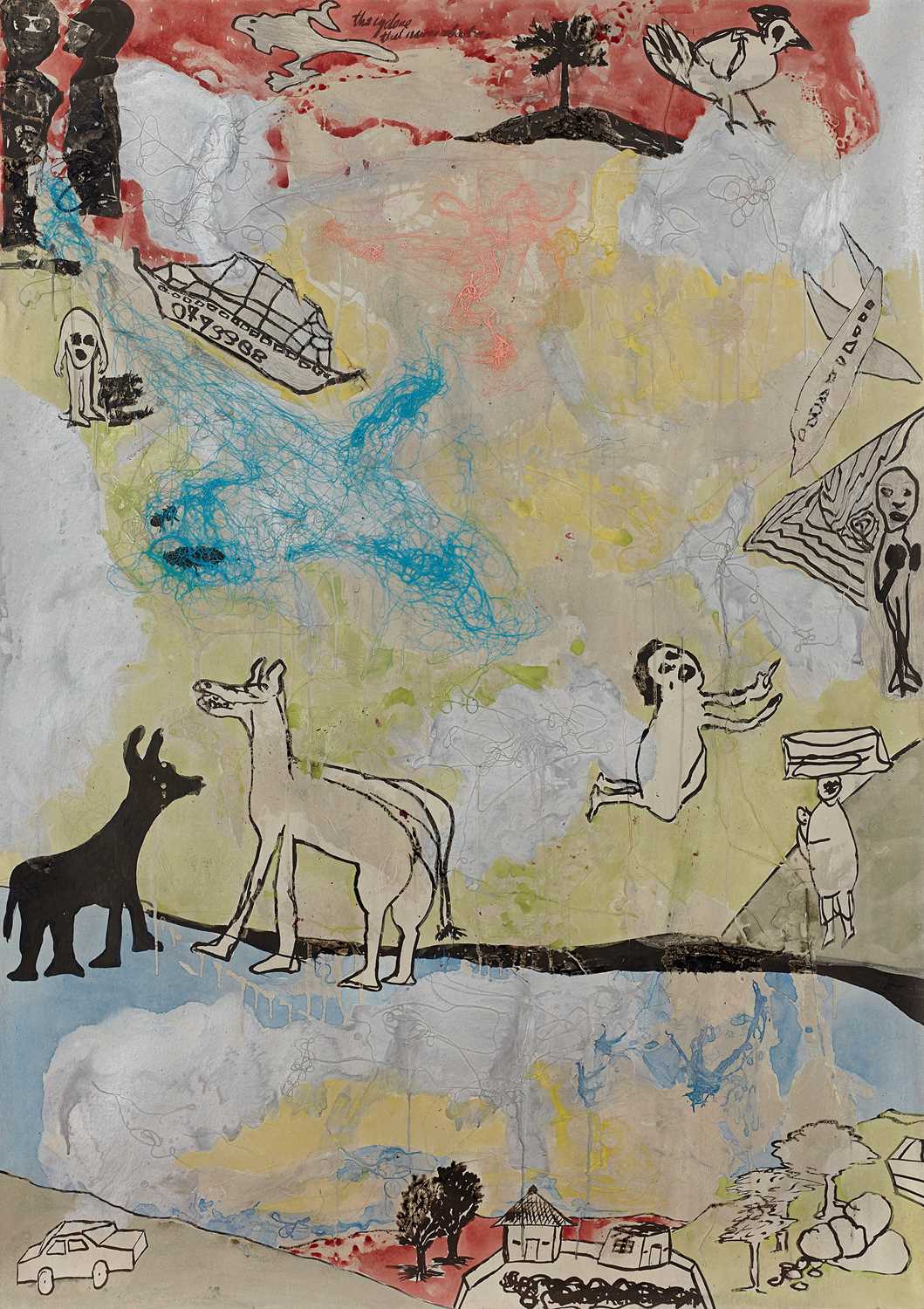
The Cyclone That Never Abates ,
Provenienza :
Exhibited :
Literature :
Note : Since the early 1990s, Moshekwa Langa’s art has been consistently elusive; on the run. Prominent American curator Hamza Walker characterized it as “consciously cryptic”.[1] Late art critic Colin Richards also weighed in, describing it as “cryptic and diaristic, his aesthetic one of wit and whimsy, a sharp feel for the game and a devotion to keeping on the move”.[2] Langa himself has described his work as being “sparked by so many different things that it is very, very possible to have more than 10 things at once because they are prompted by different desires and different needs”. [3] The painting at hand, The cyclone that never abates, expresses just that. A watery crimson hue drapes down from the top, interrupted by a microscopic cursively written inscription, “the cyclone that never abates”. The title suggests turmoil and disquiet, but the painting depicts no traces of destruction. However, it would be negligent to claim that what visually unfolds before us is ‘simple’ despite it seeming so. Here, existence itself appears merely abstracted, surrealistic, and prevaricating. Human figures, creatures, animals, boats, airplanes, birds, ships, and residencies are cartographically dispersed across the picture plane in ways that flatten the space. Dumile Feni’s The African Guernica comes to mind here, except Langa refuses us the comfort of a narrative arc. His characters and scenes, always childlike, have no clearly visible relation to each other or the viewer.There’s no intelligible disaster in this cyclone then, but instead, there’s a compositional and formal recalcitrance. A disaster is immanent in the very visual properties of the work itself. The discordant palette of turbid greys spread unevenly across the lemony acrylic, touches of watercolour, and the faint blues and pinks of woolen thread textures present a disturbing disharmony. We can sense a disaster but
Athi Mongezeleli Joja
Condition_report :