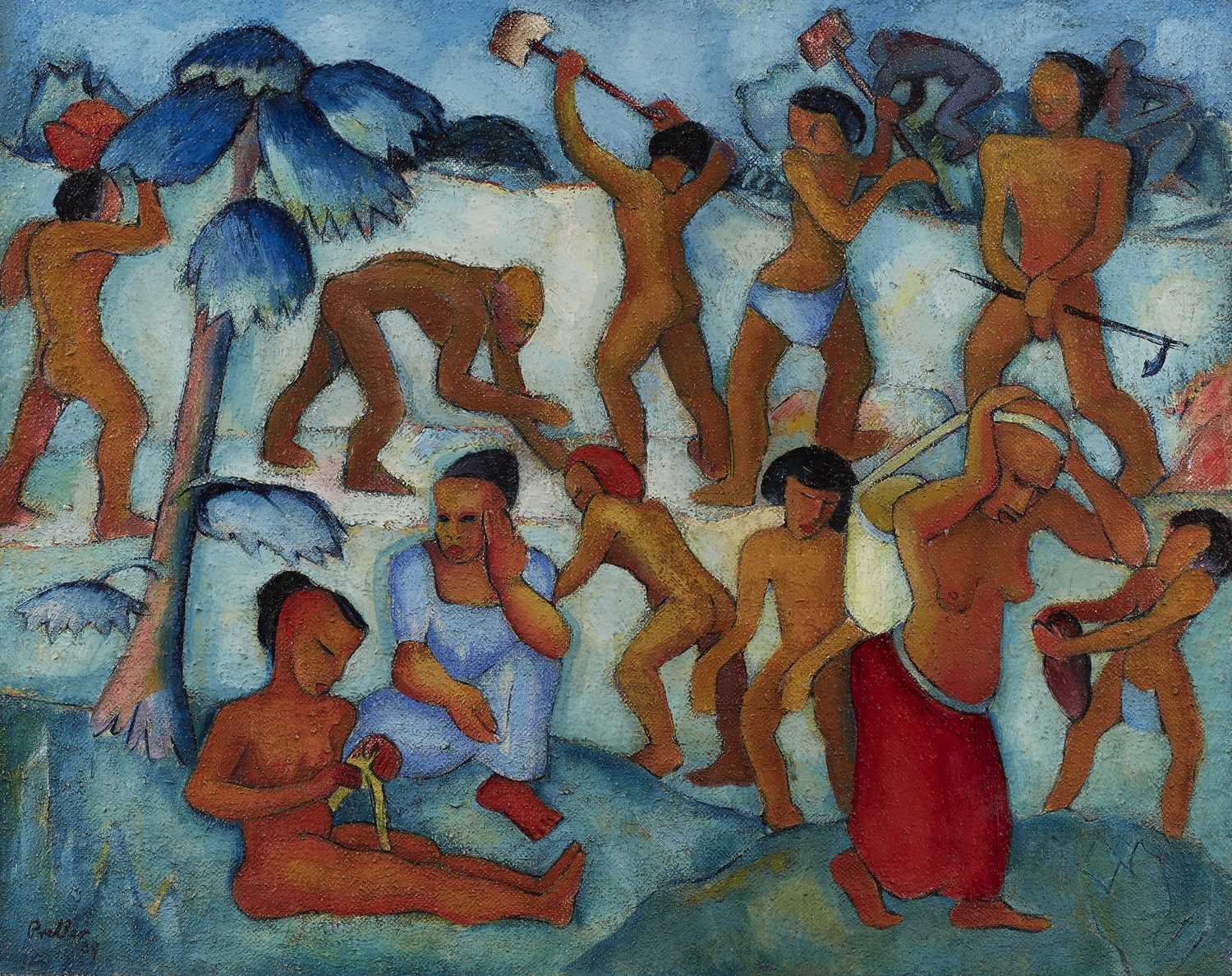
Congo Figures ,1939.0
Exhibited : Gainsborough Gallery, Johannesburg, Alexis Preller: 20 Paintings 1947, 6 to 9 June 1944, where the title ‘Congo Men’ was used. Pretoria Art Museum, Pretoria, Alexis Preller Retrospective Exhibition, 24 October to 26 November 1972, where the title ‘Congo Men’ was used. South African National Gallery, Cape Town, Paris and South African Artists 1850–1965, 14 April to 29 May 1988, catalogue number 170, where the title ‘Congo Men’ was used. Johannesburg Art Gallery, Johannesburg, Paris and South African Artists 1850–1965, 22 June to 17 July 1988, where the title ‘Congo Men’ was used. Pretoria Art Museum, Pretoria, Preller 1991, catalogue number 6, where the title ‘Congo Men’ was used.
Literature : Alexander, L., Bedford, E and Cohen, E. (1988). Paris and South African Artists 1850–1965 exhibition catalogue. Cape Town: South African National Gallery, discussed on pp.44 and 108. Berman, E and Nel, K. (2009). Alexis Preller: Collected Images. Johannesburg: Shelf Publishing, illustrated and discussed on pp.12–13. The Pretoria Art Museum. (1972). Alexis Preller Retrospective exhibition catalogue, illustrated plate 7.
Notes : Alexis Preller in 1939 was at a watershed moment in his life as an artist. His education in London earlier in the 1930s had led to a commitment to making art. This decision was rewarded early on with two solo shows in 1936, only his second year as a full-time artist, one in Johannesburg and one in Pretoria. The same year saw one of his works, Native Study (Mapogges) (sic), chosen for exhibition on the prestigious Empire Exhibition, along with work by older and more established figures like J.H. Pierneef, Maggie Laubser and Irma Stern, among others.A series of six paintings also depicting so-called ‘Mapogge’scenes was a central focus of the Pretoria solo show in that year,along with a poignant figure study entitled Man in the Sun. Inthese early works Preller’s debt to both Stern and to Vincent van Gogh is evident stylistically and in the choice of subject matter. Preller’s travels in Europe and Africa throughout the late 1930s culminated in his first visit to the Congo in 1939, with the threat of war already looming. His visit there was to paint and study local life and culture, some years before Stern’s productive travels in the same country. While the style of Congo Figures echoes Stern and his own earlier Mapogge scenes, it also has clear affinities with Paul Gauguin’s colourful post-Impressionist island scenes, especially those from his late nineteenth century paintings in Tahiti.
As Karel Nel puts it in the authoritative study Alexis Preller: Collected Images,1 in this work ‘there is a fresh, spontaneous quality about the rendering of the subject that is irresistibly appealing. It is almost as though the painting is a glimpsed fragment of the stream of life of the participants. The artist has not inserted himself into the situation and the ongoing activities are unaffected by the witness. The colour is another factor in the success of this painting. The artist had actually made the paint himself, mixing raw pigment with an oil and turpentine medium, and the combination of homemade tints worked effectively. Preller’s time in the Congo would become the source of major innovations in his work, but those developments were held in check by his active service in the War’. Indeed, Preller’s output would dry up during his active service in the Medical Corps in the war, but the debt to Gauguin would again be evident in his first significant paintings some years later, depicting as they did a transformed memory of the trauma of dealing with the wounded, such as Fleurs du Mal (1944).His Congo Figures is therefore significant because it represents the end of an era of innocence of sorts for Preller. Subsequently his depictions of similar scenes, and of Mapoggas, would be transformed by his developing personal style and mythography, as well as the personal experiences he had undergone. The painting is further distinguished by having been in the same, influential collection for over seventy years.
James Sey