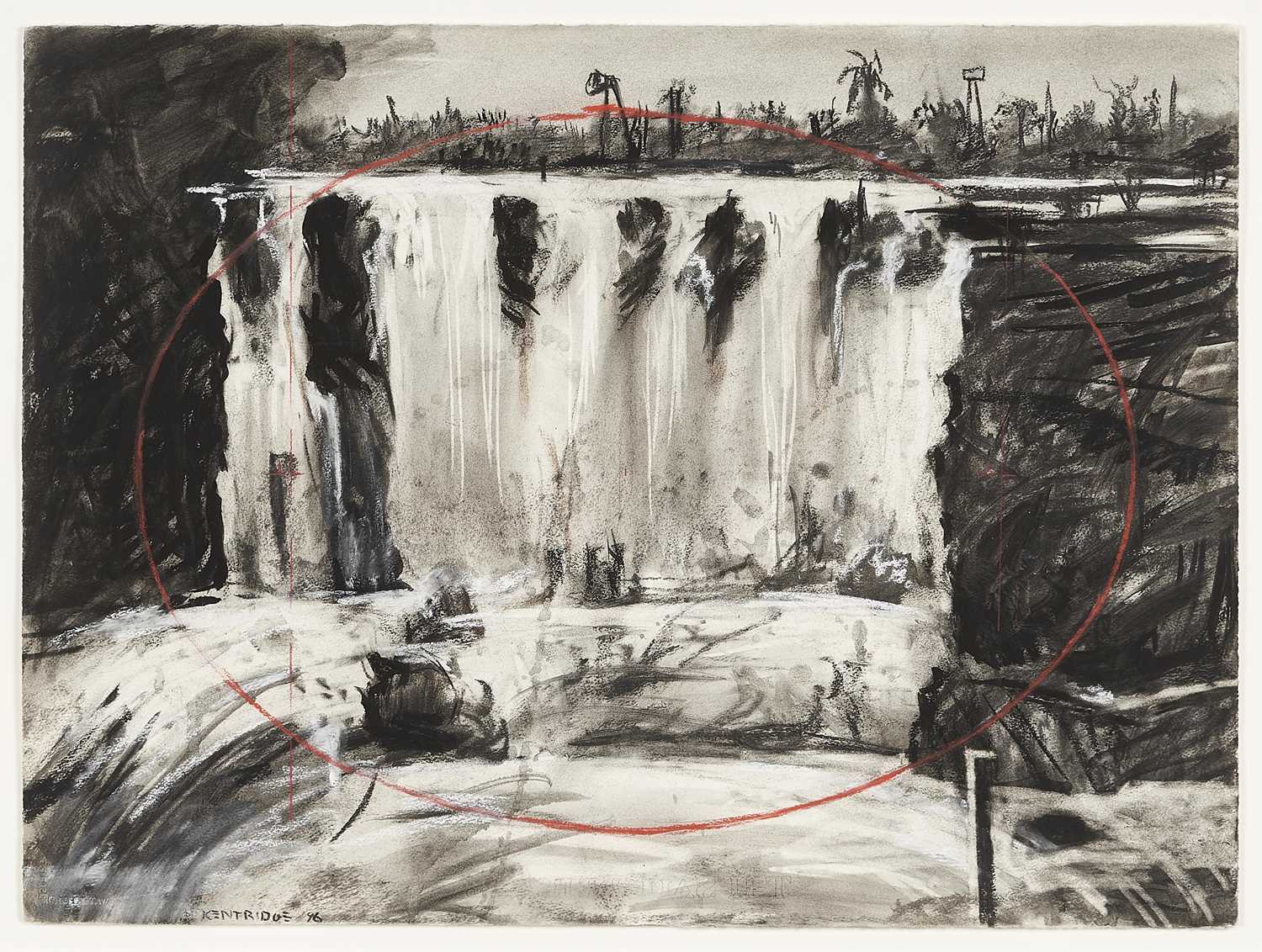
Victoria Falls (From The Colonial Landscapes Series) ,1996
Provenance :
Exhibited :
Literature :
Notes : William Kentridge’s landscape works are unmistakable. They are a significant and persistent visual motif of his entire oeuvre, forming an essential part of his thematic drawings: as evocative standalone accompaniments to his large-scale performance pieces and animated films, and as the conceptual underpinning to many other works. In terms of these drawings as works of landscape art, many commentators have remarked on his clear visual and ironic references to monumentalist landscape artists of the eighteenth and nineteenth centuries. Far from being tributes or falling into the tradition of such works, Kentridge’s landscapes are much more overtly contested and mutable terrains.The ‘colonial landscape’ drawings are particularly fine examples of scenes that we might consider ‘historical erasure’. In Kentridge’s recent international stagings of his large scale performance The Head and the Load, and the associated exhibition Kaboom! at the Goodman Gallery, Johannesburg, the importance of landscape drawing is clear. Far from being the background to or context of a scene or tableau, the landscape is a central character and employed to great narrative effect: alternating between evoking precise locations or entirely stripped of specifics, crafted to fit a globalised narrative of the First World War and Africa’s place in it.In the same way, the earlier colonial landscape drawings render implicit critiques of the struggle over the representation of territory in the colonial era. Indeed, the attempt to represent land in a particular way lies at the heart of the ideology of the colonial enterprise.
With this important landscape drawing, Kentridge’s characteristic subversion lies in the mutability of the chosen scene. The swift river and tumbling waterfall, with its heavy black rocks resisting the unceasing flow of water, is destined for human interference and erasure. A process of ownership and control will be exerted over this seemingly immanent and sublime piece of nature.Though less readily identifiable as a specific place than many of his other landscapes, the drawing is beautifully elegiac. Its mid-range perspective and the compelling central composition of the rocks suspended almost magically in the midst of the foaming white water attract the eye. Allegorical and subtle, the work is a particularly strong instance of Kentridge’s landscape drawing.
James Sey
Condition_report :