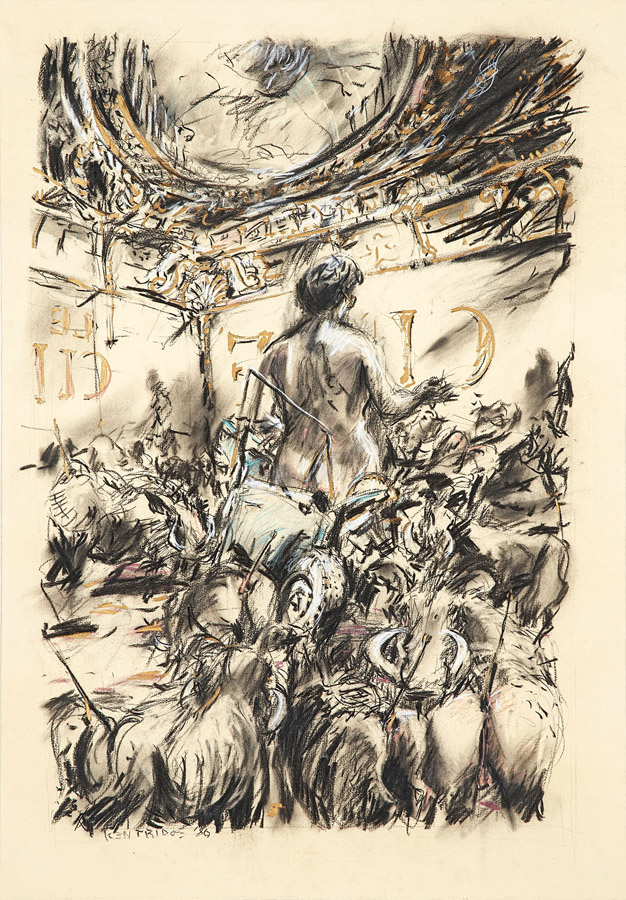
Circe ,
Provenance :
Exhibited :
Literature :
Notes : During the middle-1980s, a period of increasing political crisis in South Africa, William Kentridge produced a number of drawings focusing on the “decadence and sensuality of the haute bourgeoisie”.1 Kentridge had a unique vantage on this world. He was born into wealth, privilege and political commitment: his grandfather, Morris Kentridge, was MP for Troyeville; his mother, Felicia Kentridge, was a lawyer and prominent anti-apartheid activist; and his father, Sir Sydney Kentridge, also a lawyer, defended numerous political figures and was appointed Queen’s Counsel in 1984. Some of his charcoal drawings from this period are loosely autobiographical, while others evidence his interest in adapting western literary and artistic sources to obliquely comment on the predicaments of white privilege.
First exhibited at dealer Reinhold Cassirer’s Johannesburg art gallery, this charcoal drawing sardonically adapts Greek mythology. Circe was a minor Greek goddess endowed with magical skills. Her ability to transform men into pigs, as is recorded in Homer’s Odyssey, was a popular theme in archaic and classical art.2 In Kentridge’s adaptation, Circe’s pigs are now warthogs. As Carolyn Christov-Bakargiev has noted of his drawings from this period, drama and denunciation is met with humour and irony.3
The warthog is a recurring motif in Kentridge’s early drawings. In 1985 he produced The Boating Party, a charcoal triptych based on Pierre-Auguste Renoir’s Luncheon of the Boating Party (1881). The drawing includes a woman hugging a warthog, as well as a burning tyre, an explicit reference to the vigilante justice of the period. These two motifs – the warthog and burning tyre – recur in other drawings from 1985. This work from a year later is clearly a continuation of this cycle of drawings. It bears mentioning that in 1985 Kentridge was briefly employed as an editorial cartoonist for the Weekly Mail newspaper. He signed his cartoons, which explored themes similar to his drawings, as “PH Chere”. The French for warthog is phacochère.4 This work is an early elaboration of Kentridge’s nuanced, literate, allusive method as an artist, a method in which he is never wholly candid, declaratory or to the point.
1. Ozinski, Joyce. ‘William Kentridge’s Rich and Expressive Art’, Rand Daily Mail, May 19852. Ogden, Daniel. (2014) ‘Animal Magic’, in The Oxford Handbook of Animals in Classical Thought and Life, Oxford : Oxford University Press. Page 294.3. Christov-Bakargiev, Carolyn. (2003) ‘On Defectibility as a Resource’, in William Kentridge, Milan: Skira. Page 64 4. Andy Mason, What’s So Funny?, Cape Town: Double Storey, 2010, page 127
Condition_report :