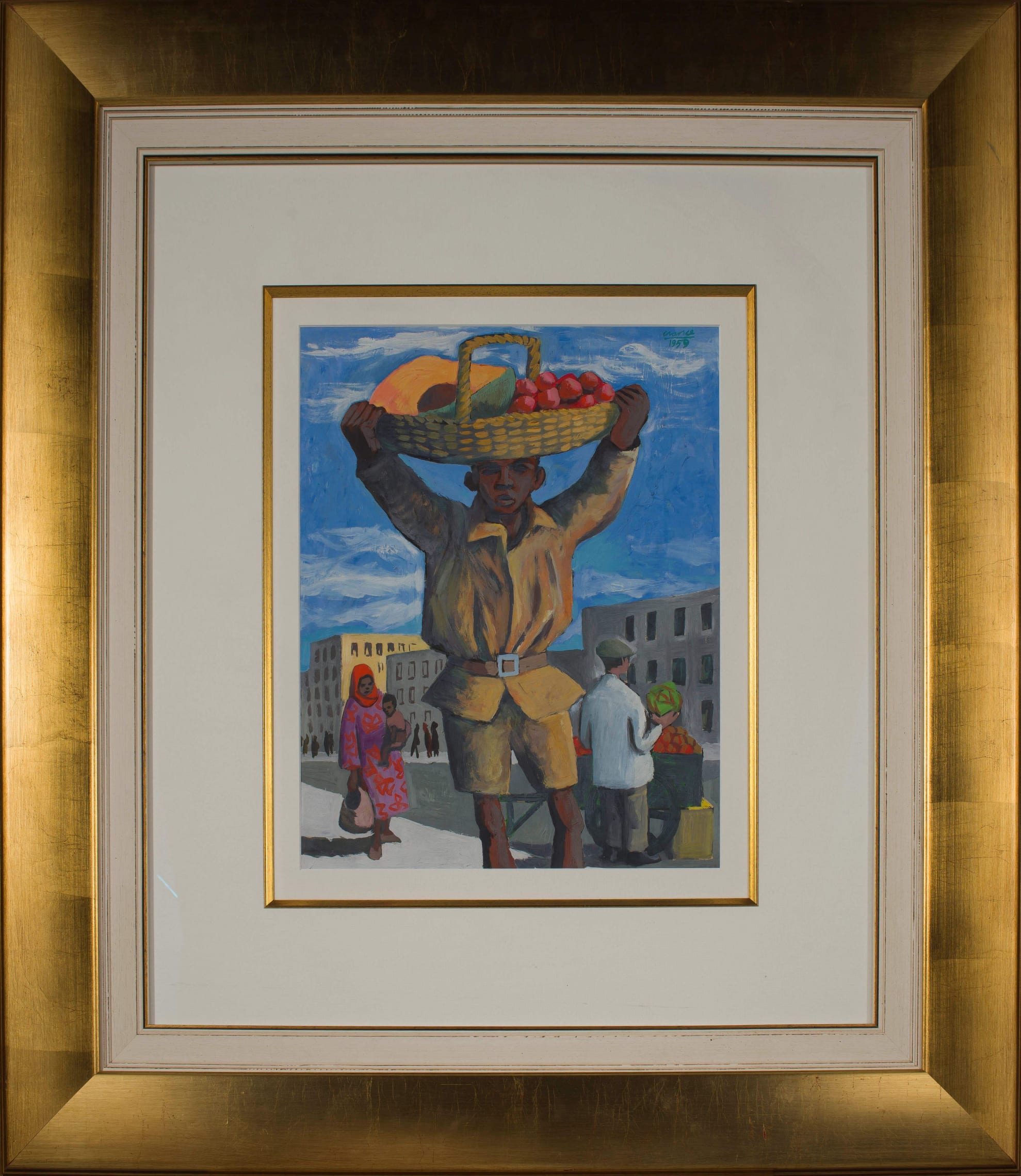
The Vendors ,1959
Provenance :
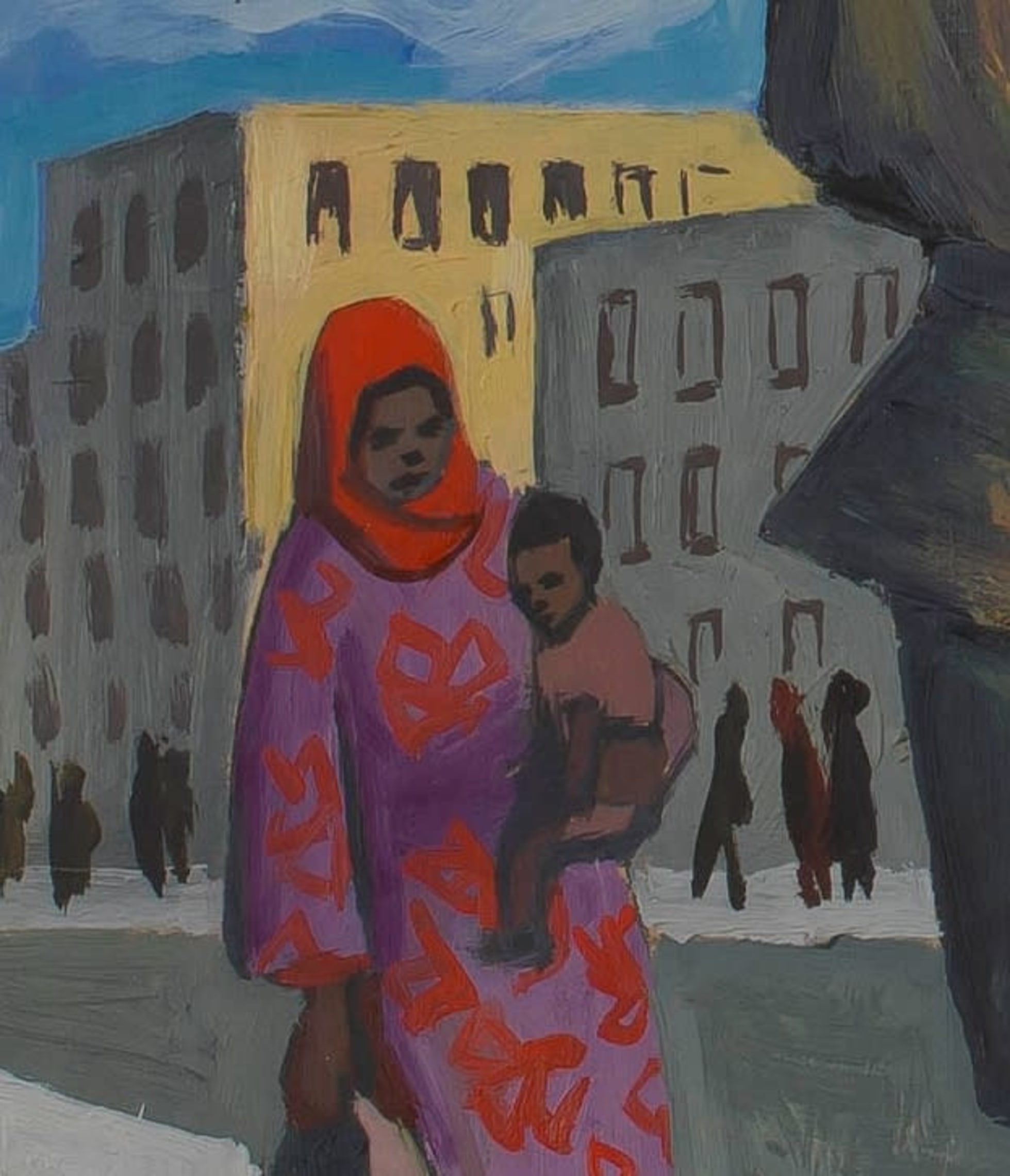
Notes : Peter Clarke fills the picture plane of the present lot with a young man or boy walking briskly towards the viewer, carrying a basket of brightly coloured fruit and vegetables on his head. He is confidently announcing his presence and advertising his delectable products. Behind him, a street runs diagonally to the left, and a few pedestrians are visible in the distance. Closer to the boy, the artist has depicted a woman with a baby, as well as a street vendor standing next to his barrow, holding a head of cabbage.
Apart from the occasional wood gatherer, washerwoman, road worker, farm worker, cattle herder, and fishmonger, Clarke surprisingly seldom depicts the theme of labour, of people at work, in his art. His paintings do show people in a specific society dealing with the specific socio-economic and political situation in the South Africa of the 1950s and 60s. The fruit vendor does not draw attention to himself as some sort of symbol of the nobility of work but does tell the viewer something about the society in this country at that time.
Many other prominent South African artists also created images of informal traders and street vendors earning their living: Irma Stern painted African Woman with the products dwarfing the seller, suggesting the fecundity of the earth, Vladimir Tretchikoff celebrated the abundance and exoticism of the East in his famous Fruits of Bali, and Rupert Shephard illustrated many informal traders, from basket sellers to flower sellers and fruit sellers, in one of his famous linocut artist’s books, Passing Scenes: Eighteen Images of Southern Africa.
In Clarke’s The Fruit Vendor, the prevailing social stratification is evident. The boy is wearing a uniform of khaki shorts and shirt, commonly worn by those patronisingly known at the time as ‘house boys’. Soon after his marriage to Grace Andersen, Walter Battiss wrote to his parents about how he had just appointed a ‘house boy’ and fitted him out with just such a uniform. This gives rise to another potential reading of Clarke’s painting: is the boy in fact selling the contents of his basket, or has he just bought fruit and vegetables from the street vendor with the barrow and is now rushing back to his employer’s kitchen?
This work is one of the most accomplished and significant oil paintings by a South African master perhaps better known for his gouaches. It is a high point in his Tesselaarsdal period of the late 1950s and early 60s, and anticipates the more overtly political works of the 1970s and 80s.