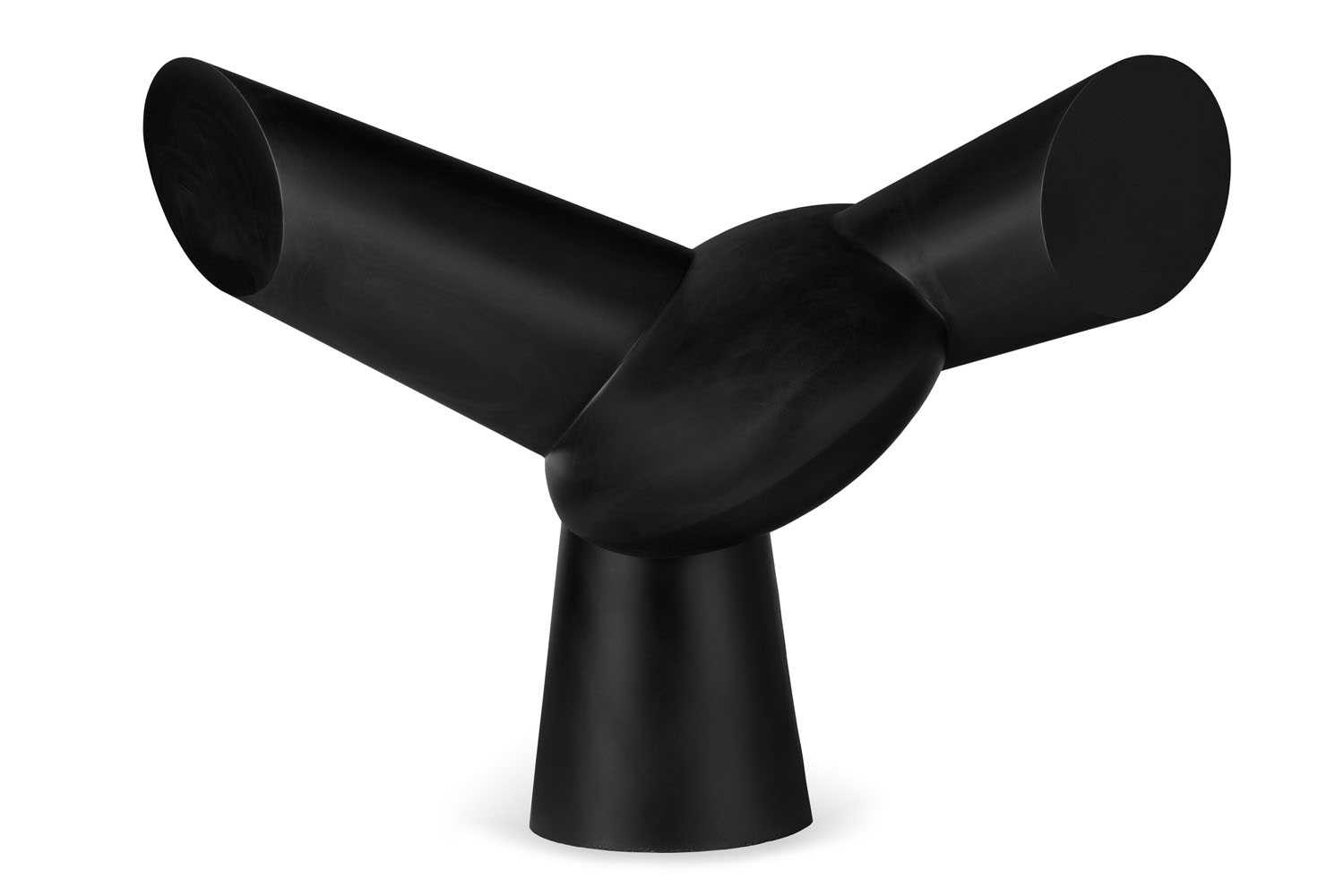
Sculpture VIII ,1970.0
Literature : Nel, Karel. (2005). Villa at 90. Johannesburg: Shelf Publishing, illustrated on p.140.
Notas : This monumental work in steel was created at the end of the 1960s, the most tumultuous and influential period in Edoardo Villa’s long career. Its extended forms and starkly elegant simplicity are characteristic of other works from the same period, like the Maquette proposal for Jan Smuts airport. During this time, Villa was searching for a range of conceptual and visual solutions to the challenge of representing his hybrid identity as a sculptor of European origin working in Africa. His association with the Amadlozi Group through the 1960s is much remarked upon. While Amadlozi had no doctrinal artistic manifesto as such, it was driven by founder Egon Guenther’s conviction that artists should draw on their own experiences and milieu in order to create. This meant that Villa, for one, had to find ways to reconcile his European heritage and training with his African experience and visual source material. As with the other Amadlozi sculptors, Sydney Kumalo and Ezrom Legae, Villa drew on his exposure to Guenther’s African art collection, as well as that of his other friend Vittorino Meneghelli, to fashion his own unique visual language. As Karel Nel points out in the book Villa at 90, the extended forms projecting dramatically outward from the tapering base of the piece recall the great Songe Kwifebe masks of the Democratic Republic of Congo: ‘In the Songe masks, [viewers] … cannot mistake this face for that of a living being. Rather it represents that of a powerful, ancestral spirit whose extended senses are associated with altered consciousness and the supersensory ancestral world’ (2005:140). While Villa’s commitment to a graceful abstraction is present in this imposing and balanced piece, the spirituality of its African identity also shines through.
James Sey