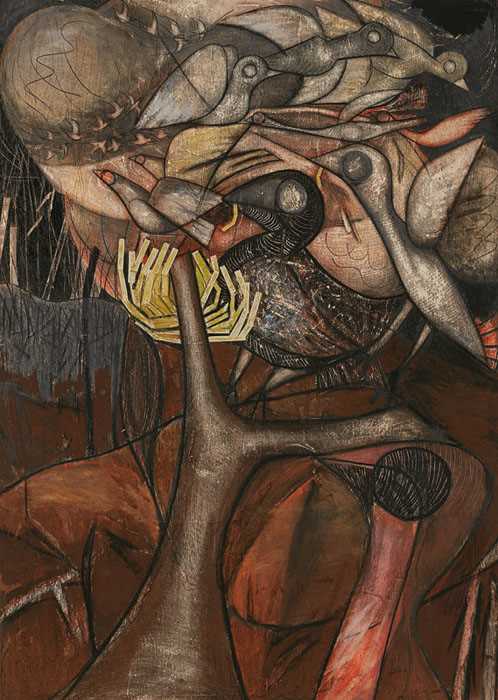
Flight ,1967
Notas : As a high school learner Maqhubela enrolled for classes at the Polly Street Art Centre in Johannesburg, where he received tuition from Cecil Skotnes and Sydney Kumalo. Sometime during 1963-64 he met with Giuseppe Cattaneo at the University of the Witwatersrand and received brief but fruitful instruction on how to use oils on paper, make monotypes and draw with two pieces of conté crayon, one red and one black.Technically and stylistically comparable to Exiled King (Aspire catalogue, Autumn 17, lot 59: 44), Flight is another fine and rare example of Maqhubela’s conté crayon drawings of the mid-1960s. Birds and trees fill the picture surface, they become one as they merge and overlap and are given palpable volume in subtle Venetian reds, yellows and greys. Solid black lines define and unify, and by scratching into the paper Maqhubela adds highlights, details and texture. A nest of masking tape is collaged around a tree trunk. The subject matter shifts from an incarcerated personage in Exiled King to birds taking flight. However, the connection between the personal and political in Maqhubela’s oeuvre, life and philosophy is no less compelling. For him, birds symbolise the soul that is free to soar, unencumbered by the confines and divisions that we create, this is revealed in his poem, Flight, which relates directly to the drawing (Martin 2010: 13):
The call of the dove in the leafy bough yonder
Cries my boy,
My boy
Have you not your morning chores begun?
The flutter of the whistling circle calls
My heart to burst its
Prison
Bar Rib
Enclosure
Satellite the circling music soft and
Hush!
See the moon
When he won the overall (not designated for black artists) ‘Artist of Fame and Promise’ Award in 1966, Maqhubela became the first to cross the divide between black and white artists. He enjoyed commercial and critical success in South Africa, but settled in London primarily for political reasons in 1976.
Marilyn Martin